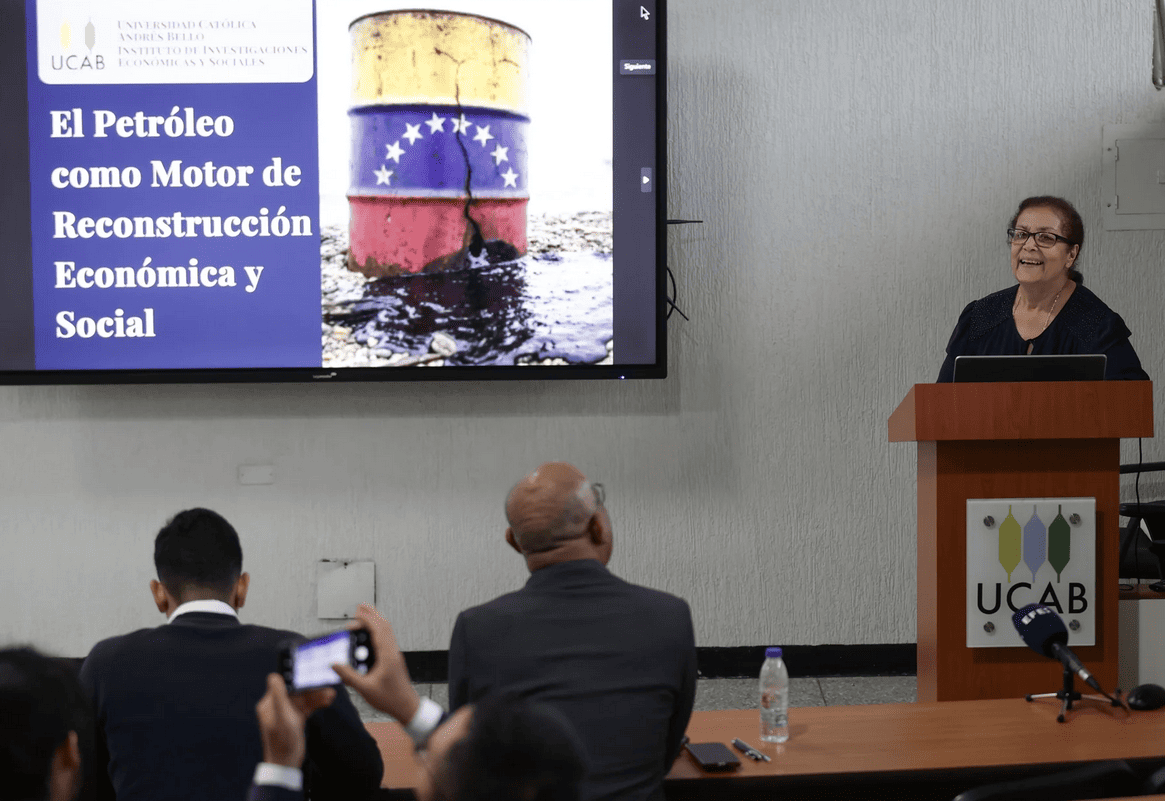
EFE — Venezuela’s oil sector development following the opening to foreign investment promoted by the United States will depend largely on political stability in the South American country, several economic experts told EFE on Monday after participating in a forum at the Andrés Bello Catholic University (UCAB).
Economist Luis Zambrano Sequín argued that no one will make medium- or long-term investments in a country that “fails to demonstrate” strong institutions and political stability, which he described as “a guarantee that agreements, contracts, and new arrangements will endure.”
“If people lack confidence that political agreements exist around fundamental issues shared by society as a whole, then, clearly, in sectors such as oil and mining, where projects take decades to mature, no one will take on risks of considerable magnitude,” warned Sequín, a member of UCAB’s Institute for Economic and Social Research (IIES).
Following the capture of Nicolás Maduro last January, Venezuela’s interim government, led by Chavista leader Delcy Rodríguez, has opened strategic sectors such as oil, mining, and electricity to international investment, with support from Parliament, which the ruling party controls and is presided over by her brother, Jorge Rodríguez.
At the same time, the head of state has gradually dismantled Maduro’s cabinet, renewed the military high command, promoted an amnesty and hundreds of releases of political prisoners, and announced a government restructuring process. Meanwhile, the United States is encouraging negotiations between the current Parliament and the opposition-majority 2015 National Assembly, which continues to defend its legitimacy, to accelerate the transition.
Sequín said political stability “becomes a key factor” in this context, as does the relationship between Venezuela and the United States, an issue that, he added, still lacks clarity.
Economist María Antonia Moreno, also a member of the IIES, stated that attracting additional investment depends “to a large extent” on political stability and on the credibility of both the Venezuelan state and private companies.
In her view, public institutions need stronger technical and political expertise to defend the nation’s interests in contractual negotiations.
For his part, sociologist and oil market researcher Blas Regnault, who participated remotely in the forum, said he does not believe oil will become the engine of Venezuela’s economic reconstruction unless the country first resolves “the sector’s accumulated governance crisis.”
He also stressed the need for “legal certainty” and “greater transparency for investment.”