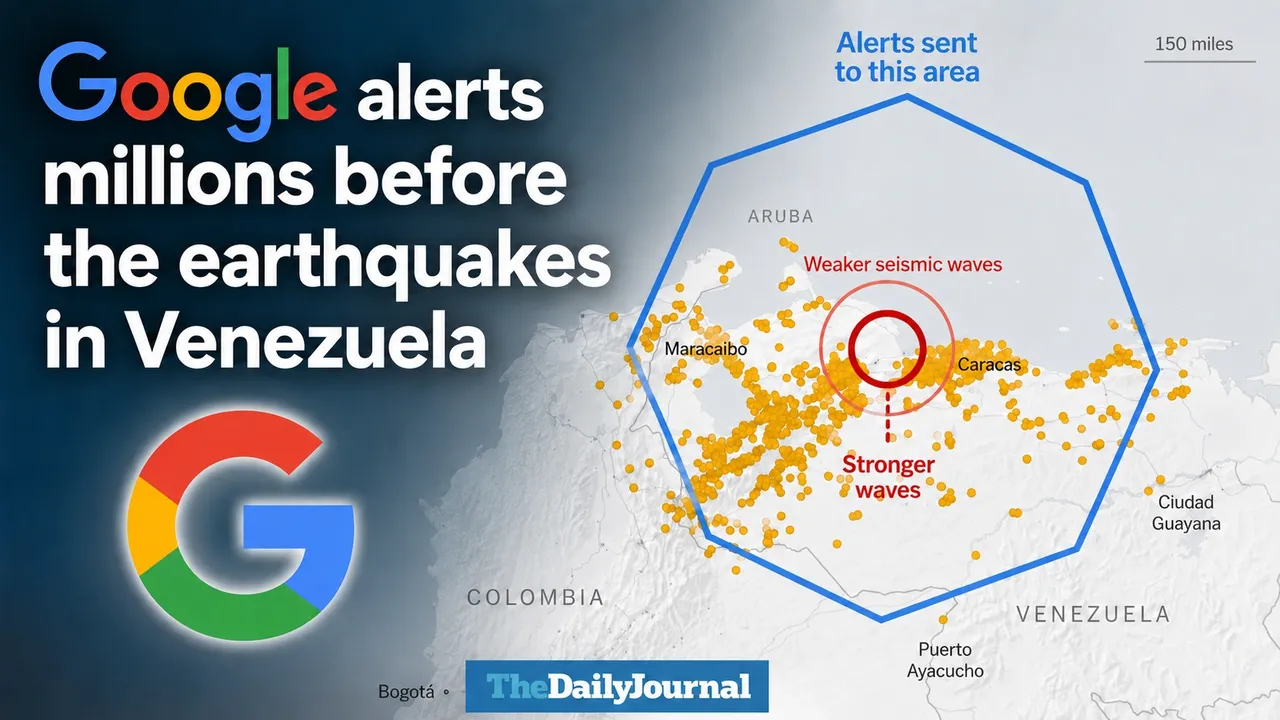
Julio A. López, Editor in Chief.- Millions of Venezuelans received earthquake warnings on their Android phones seconds before two powerful earthquakes struck north-central Venezuela, in one of Google’s strongest demonstrations yet of its global earthquake early warning system.
Although Venezuela does not have a national earthquake early warning network, the Android Earthquake Alerts system detected the first seismic waves via the accelerometers built into thousands of mobile phones in the affected area. From there, just three seconds after the first earthquake began, the devices started to register the primary (P) waves, which pose virtually no danger, and started to send that information to Google’s servers.
Six seconds later, the platform had already identified the event as an earthquake and had issued the first alerts. Then, in just 21 seconds, the warnings had reached millions of phones across a vast region of the country, providing from a few seconds to nearly two minutes of advance notice, depending on the distance between each user and the epicenter.
Google reported that approximately 11.4 million people received some type of warning before or during the earthquake sequence. Of those, about 1.4 million people received the highest-priority alert, called “Take Action,” for areas where the strongest shaking was expected.
The system also faced an exceptional challenge: the second earthquake, with a magnitude of 7.5, occurred just seconds after the first one, with a magnitude of 7.2. As a result, according to Google’s engineers, the seismic waves from both events overlapped, so the system’s intelligence interpreted the sequence as a single major seismic event and progressively expanded the warning area as the magnitude increased.
Unlike the traditional systems used by countries such as Japan, Mexico, the United States, and Canada, which rely on government networks of underground sensors, Google’s technology turns millions of Android phones into a gigantic distributed seismic network. In this way, when the devices remain still—for example, on a table or on the floor—they can detect the initial ground vibrations and transmit that information in real time to calculate the earthquake’s location, magnitude, and evolution.
Currently, about 70% of the world’s smartphones run Android, enabling the system to operate even in countries without their own earthquake early warning infrastructure. Since its launch in 2021, the platform has expanded to 98 countries and become one of the world’s largest early detection networks.
Specialists point out that, although a few seconds may seem insignificant, that margin may provide enough time to leave unstable structures, stop industrial operations, protect critical equipment, or follow the international recommendation to “Drop, Cover, and Hold On,” which significantly reduces the risk of injuries during a major earthquake.