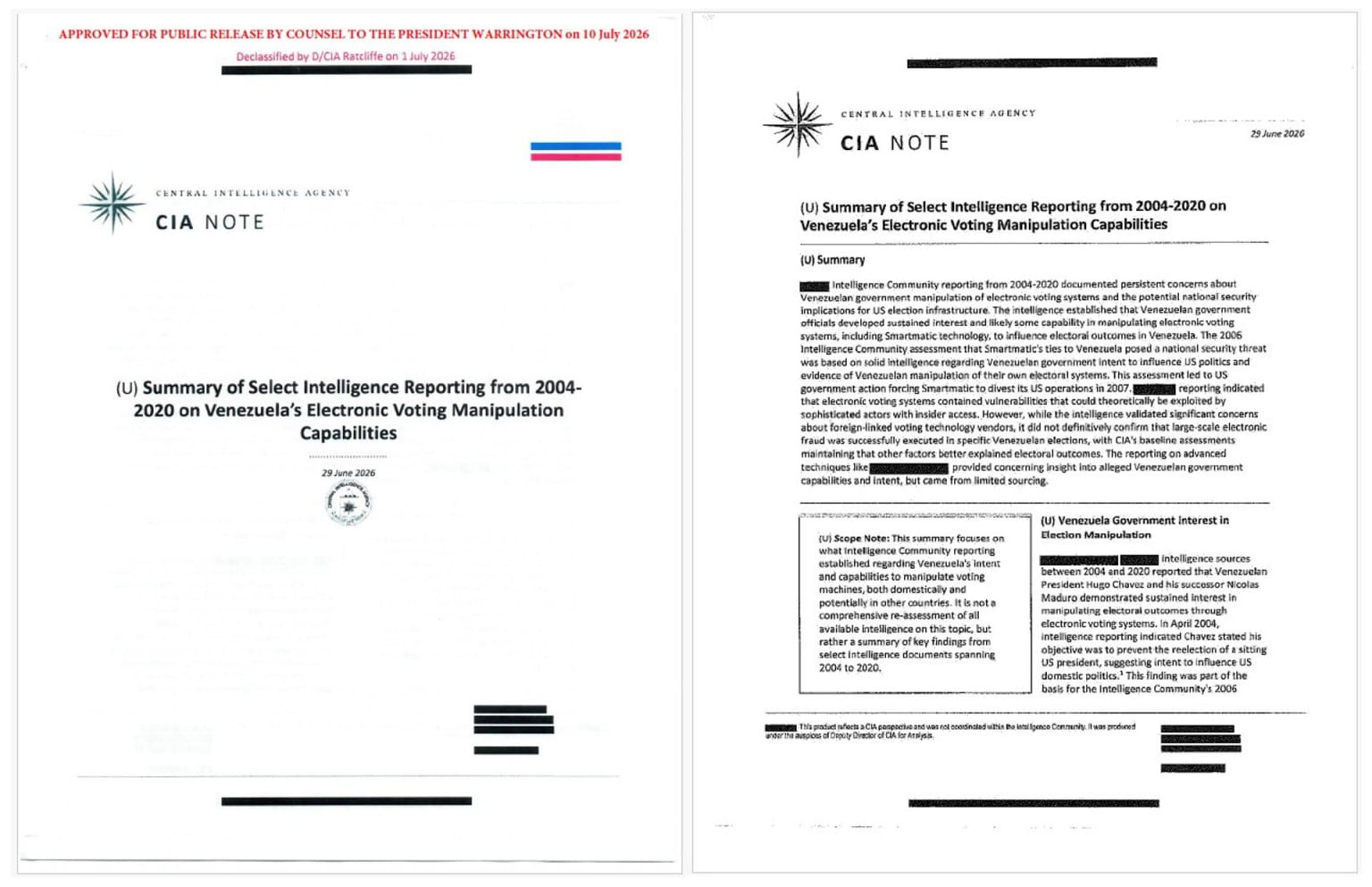
The CIA document compiles intelligence reports on alleged plans, technical vulnerabilities, and links between government officials and Venezuela’s electoral system. The agency states that its assessments did not confirm large-scale electronic fraud in any specific election.
The Daily Journal. — A declassified report from the U.S. Central Intelligence Agency (CIA) compiles intelligence assessments conducted between 2004 and 2020 regarding the Venezuelan government’s technical capabilities and alleged intentions to manipulate electronic voting systems, including technology developed by Smartmatic.
The document that Donald Trump presented Thursday night is titled “Summary of Selected Intelligence Reporting from 2004 to 2020 on Venezuela’s Electronic Voting Manipulation Capabilities.” The CIA completed the report on June 29, 2026. CIA Director John Ratcliffe declassified it on July 1, 2026, and the agency approved it for public release on July 10.
According to the summary, reports from the U.S. Intelligence Community identified “persistent concerns” throughout that period regarding the Venezuelan government’s potential to manipulate electronic voting systems and the implications of such actions for U.S. national security.
The CIA states that its assessments concluded Venezuelan officials “developed a sustained interest and likely some capability to manipulate electronic voting systems,” including technology associated with Smartmatic, to influence election results inside Venezuela.
However, the document also establishes a key limitation: U.S. intelligence did not definitively confirm that large-scale electronic fraud took place in any specific Venezuelan election.
“While intelligence validated significant concerns regarding foreign-linked voting technology providers, it did not definitively confirm that large-scale electronic fraud was successfully carried out in specific Venezuelan elections,” the report states.
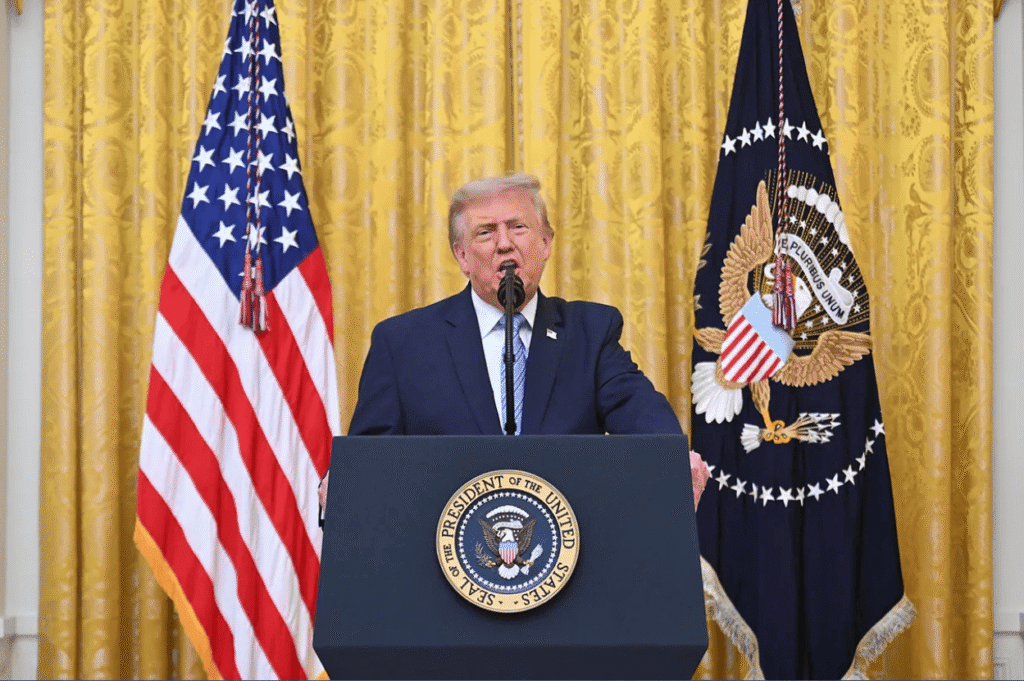
Donald Trump during the presentation of the CIA’s declassified files. Thursday, July 16.
Reports on alleged election manipulation plans
The document compiles intelligence reports pointing to an alleged interest by the Venezuelan government, during the administrations of Hugo Chávez and Nicolás Maduro, in using technological mechanisms to influence electoral processes.
One of the episodes described concerns the 2012 presidential election. According to the CIA, intelligence sources reported that agencies such as the General Directorate of Military Counterintelligence (DGCIM) and the Bolivarian National Intelligence Service (SEBIN) allegedly worked alongside the National Electoral Council (CNE) and Smartmatic on plans to manipulate election results through pre-programmed voting machines.
According to those reports, the alleged plan involved deploying modified voting machines at approximately 300 polling centers located in areas that traditionally supported the ruling party, to secure a margin of roughly 1.5 million votes.
The CIA states that, after Chávez defeated Henrique Capriles by approximately 1.6 million votes, some sources reported that the Venezuelan president congratulated his team for carrying out the plan.
Nevertheless, the report makes clear that the CIA’s primary assessment found no conclusive evidence of large-scale electronic fraud in that election.
“The CIA’s baseline assessment held that no large-scale electronic fraud occurred in 2012, based on pre-election polling data, the absence of irregular voting patterns, and the opposition’s concession.”
The 2020 technical scenario
The document identifies intelligence reports from 2020 as the most detailed description of a possible election manipulation technique.
According to those reports, Venezuela allegedly developed a mechanism using virtual machines to replicate legitimate election results and replace them with manipulated data in electoral databases.
The CIA describes a technique that allegedly replicated digital files used to validate election results, simulated genuine voting machines, replaced records linked to polling centers, and made altered votes appear to originate from legitimate equipment.
The agency indicated that, in theory, this method could alter election results while bypassing traditional audit mechanisms.
However, the report also states that the Venezuelan government allegedly did not need to carry out large-scale electronic manipulation during the December 2020 parliamentary elections because much of the opposition boycotted the vote and the government already exercised political control over segments of the opposition.
Smartmatic and U.S. security concerns
The report devotes part of its analysis to the relationship between Venezuela and Smartmatic, the company that supplied election technology to Venezuela’s electoral system for several years.
The CIA recalls that, in 2006, the U.S. National Intelligence Council assessed Smartmatic’s acquisition of the American company Sequoia Voting Systems as a “moderate overall threat to U.S. national security interests.”
According to the report, that assessment relied on intelligence suggesting that the Venezuelan government sought to influence U.S. politics and allegedly manipulated Venezuela’s electoral system.
In that context, the agency highlights alleged links between Smartmatic executives and Venezuelan intelligence agencies, as well as relationships between Venezuelan officials and the company. It also notes that Smartmatic and Sequoia held contracts in approximately 400 U.S. counties.
As a result, the Committee on Foreign Investment in the United States (CFIUS) pressured Smartmatic to divest Sequoia in 2007.
Later, in 2018, Smartmatic ended its operations in Venezuela and accused Nicolás Maduro’s government of altering voter turnout figures during the 2017 National Constituent Assembly election.
CIA stresses the limits of its findings
The declassified report includes several cautions regarding the scope of its assessments.
The agency states that, although it identified technical vulnerabilities within Venezuela’s electronic voting systems, the ability to manipulate elections depended on comprehensive control over the electoral process, including equipment procurement, software programming, machine storage, audits, and system administration.
The CIA also states that it found insufficient evidence to conclude that Venezuela could replicate those capabilities outside its own territory.
“Neither the Venezuelan government nor Smartmatic would possess such a comprehensive level of access during an electoral process outside Venezuela,” the document states.
The report concludes that its findings constitute a compilation of intelligence on the capabilities, risks, and intentions associated with Venezuela’s electoral system. It does not constitute a definitive determination that electronic fraud occurred in every election examined.