Listen to the editorial audio here: https://clyp.it/02cbhnwd
Julio A. López, Editor-in-Chief .— Venezuela has for years ranked among the permanent strategic priorities of the U.S. intelligence community. For the National Security Agency, this means continuous, multidimensional monitoring of the country that goes far beyond ad hoc responses to political or humanitarian crises.
The objective of this intelligence architecture is to provide policymakers in Washington with the information needed to safeguard U.S. strategic interests and anticipate developments that could affect them.
This surveillance relies on sophisticated signals intelligence (SIGINT) capabilities and highly specialized organizations, including the Special Collection Service (SCS), the joint CIA-NSA unit responsible for particularly sensitive technical operations. Its capabilities include the interception and analysis of satellite communications, military and civilian transmissions, internet traffic, and telephone metadata, among other intelligence sources.
Twenty-First Century Intelligence
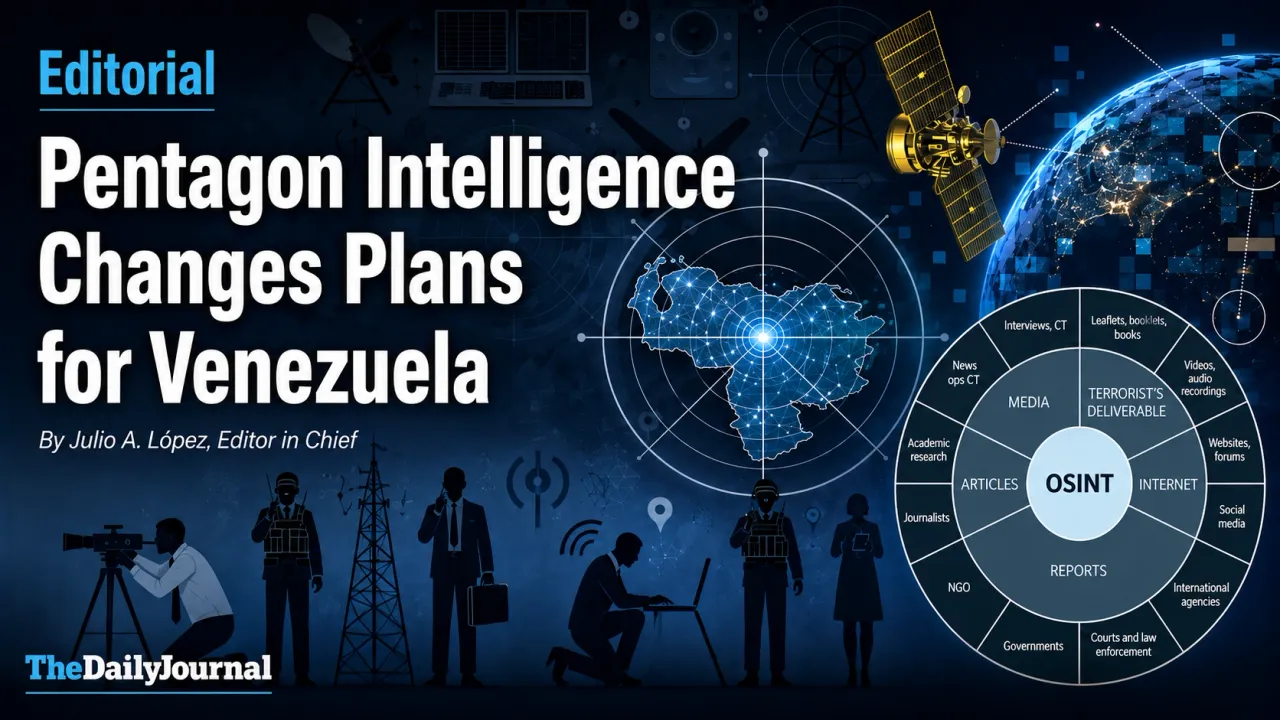
What makes this surveillance architecture particularly significant is its integration with other intelligence disciplines, including OSINT (Open Source Intelligence), GEOINT (Geospatial Intelligence), and cyber intelligence. Every day, the U.S. intelligence community processes millions of data points from social media, digital news outlets, Telegram channels, WhatsApp messages, satellite imagery, and other open sources, using artificial intelligence and large-scale data-mining tools.
These capabilities make it possible to assess in real time variables such as levels of public support for or opposition to the Venezuelan government, the country’s capacity for social mobilization, reactions to political and economic decisions, and even the influence of foreign actors on the national public debate.
This technological capability, developed over decades, helps explain why the recommendations the Pentagon recently conveyed to the State Department regarding growing discontent detected both within the Venezuelan military sector and among the civilian population were not based on improvised assessments or exclusively political considerations, but rather on the analysis of an extraordinary volume of information processed in real time.
Venezuelan Politicians
Venezuelan politicians often make the same recurring mistake: believing they are part of the circle that makes major strategic decisions. The reality is far more complex.
The United States maintains working relationships with political actors across the spectrum whenever doing so serves its national interests. It may work with opposition leaders, government officials, business executives, or representatives of civil society. But U.S. foreign policy is guided exclusively by the interests of the United States.
History shows that Washington does not formulate its strategies around the needs of local political actors. It incorporates them, supports them, or replaces them as circumstances require. Believing otherwise reflects a profound misunderstanding of how great powers operate.
Massive Assistance for Venezuela
Sources consulted by The Daily Journal in Washington said President Donald Trump could announce today, during a televised address to the nation, a series of extraordinary measures related to Venezuela. These would reportedly include approximately US$3 billion in reconstruction assistance, the deployment of about 3,000 specialists and advisers from the U.S. Army Corps of Engineers—composed primarily of highly qualified civilian personnel—and an increase in the U.S. military presence in Venezuelan territory over the coming weeks.
U.S. Southern Command has publicly acknowledged the presence of approximately 2,000 personnel involved in assistance operations in Venezuela. However, the logistical capability currently deployed in the Caribbean and off Venezuela’s coast would allow that contingent to be expanded significantly should circumstances require it. The U.S. ships currently deployed near La Guaira alone have crews numbering in the thousands.
Washington does not improvise when making decisions about Venezuela. Its conclusions are typically supported by one of the world’s most sophisticated intelligence systems. Venezuelans’ growing discontent did not reach Washington through local political leaders, but through the U.S. military intelligence network.
The events of the coming hours could confirm that the White House has not only changed its plans for Venezuela. It has also decided to accelerate them.