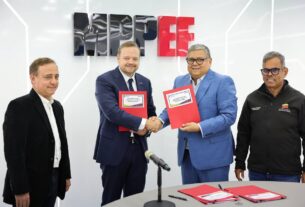
The Daily Journal – The announcement of the oil agreement between Venezuela’s acting president, Delcy Rodríguez, and U.S. President Donald Trump has triggered a wave of criticism from figures who have held some of the highest positions in Venezuela’s energy sector.
Former oil ministers and former PDVSA presidents from across the ideological spectrum have questioned the agreement, although they have emphasized different concerns.
The agreement, announced last Friday, would give the United States “majority control” over 17 oil fields with a proven potential of 65 billion barrels of oil, equivalent to approximately 21.5% of Venezuela’s reserves. The Venezuelan government says the agreement will bring more than $100 billion in investment and generate around $209 billion in government revenue.
Rafael Ramírez, who served as PDVSA president and oil minister during much of Hugo Chávez’s presidency (2004-2013), has emerged as one of the agreement’s most vocal critics.
On his X account, Ramírez wrote: “It will certainly go down in history for surrendering the country and opening the doors to a new form of U.S. colonialism. An agreement reached behind the country’s back, clearly unconstitutional, that hands control of the territory and oil over to a foreign power.”
The former minister argued that the agreement violates Articles 11, 12 and 13 of the Constitution, which establish State sovereignty over the industry, the inalienable nature of oil deposits and the prohibition against ceding territory to foreign powers. Ramírez also questioned the agreement’s economic terms:
“They handed over 65 billion barrels of oil, 17 oil fields, to ‘obtain’ meager revenues. Between 2004 and 2013, in just nine years, we delivered $700 billion in oil revenues to the country, of which $500 billion came from tax revenues.”
He also projected total revenues of $202 billion in exchange for 65 billion barrels, which would amount to a royalty of only 3.7%, lower than the rate Venezuela charged during the dictatorship of Juan Vicente Gómez. Ramírez interpreted the speed of the announcement as an electoral message from Trump ahead of the November 2026 Senate elections.
At the opposite end of the political spectrum, economist Ricardo Hausmann, a professor at Harvard University’s Kennedy School of Government and a former planning minister in the 1990s, directed his criticism at U.S. Secretary of State Marco Rubio.
“Secretary Marco Rubio: You have just lost all the trust Venezuelans once had in you, and this will haunt you,” Hausmann wrote on X. The economist accused Rubio of choosing to use U.S. power “not to liberate Venezuelans, but to get into bed with our oppressors.”
Hausmann described the agreement as “an asset grab” and “an unconstitutional deal with an illegitimate and oppressive government.” He argued that the United States should have used its leadership first to restore constitutional order and democracy in Venezuela, “and then deal with a legitimate government that could have made credible long-term commitments.”
“This announced agreement will not hold,” he warned, adding that no major U.S. oil company will take it seriously “because they know it will not last.”
Manuel Quevedo, who served as oil minister and PDVSA president from 2017 to 2020, described the negotiations as an “American fire sale.”
“I left, and they took over PDVSA. Some ended up in prison; others fled, and in the end, after so much infamy, all we got was a sad ‘American Fire Sale.’ I will never forget such disgrace,” Quevedo wrote on social media. He also questioned the Venezuelan government’s failure to disclose the agreement publicly.
Quevedo defended his own record at PDVSA and said he never acted on behalf of foreign interests: “I did not surrender to foreign interests; I confronted internal betrayal and defended Venezuela. When the moment came, I stood on the front line. I am ashamed for them, and the country’s future pains me.”
Prominent geologist and former Energy and Mines Minister Humberto Calderón Berti took a more technical approach, focusing on the agreement’s legal and fiscal uncertainties. During an interview, Calderón Berti questioned: “It is very difficult to talk about something that is still up in the air… Nobody knows what legal framework they intend to apply. Is it the current law?”
He pointed to what he described as an inconsistency in the national government’s rhetoric. Historically, it rejected foreign interference, yet today it conducts negotiations to hand over control of more than 65 billion barrels.
The former minister recalled that the Organic Hydrocarbons Law establishes a 30% royalty and a 50% income tax for joint ventures—conditions that, in his view, make large-scale development of the Orinoco Oil Belt unfeasible without a profound restructuring of tax laws.
“If we are going to undertake something of this magnitude, why don’t we do it properly?” he said. Despite his doubts, Calderón Berti acknowledged the United States’ urgent energy needs, as the country faces long-term consumption that exceeds its domestic production capacity. Still, he insisted that “Venezuela cannot accept agreements under just any terms.”
In contrast, the ruling party has backed the agreement. The United Socialist Party of Venezuela (PSUV) expressed its “full support” for acting President Delcy Rodríguez and the energy agreements, arguing that “the goal is to take advantage of every possible tool, within the hydrocarbons framework, to serve national development.”
Roberto Smith Perera, a Venezuelan businessman and political leader, has emerged as one of the most prominent voices defending the agreement, in sharp contrast with the former ministers’ criticism.
Through his X account, Smith Perera challenged what he considers a “mistaken premise” surrounding the interpretation of the “majority control” that the United States would obtain over 65 billion barrels.
“It does not mean that the U.S. receives 65 billion barrels for FREE,” he clarified, explaining that these are “reserves that private capital and technology will develop.” According to the businessman, each barrel produced “will involve costs, corporate participation, royalties, taxes and revenues for Venezuela.”
Smith Perera also criticized decades of inaction by Venezuelan governments, arguing that “over the past 30 years, we have produced barely 23.5 billion” barrels.
Against this backdrop, he contrasted that record with the U.S. proposal, arguing that “producing 3 million barrels per day for 60 years would be magnificent” and that “the tragedy would be leaving them underground for 100 years generating ZERO dollars.”
His defense of the agreement rests on a pragmatic view of energy sovereignty: “Energy sovereignty does not mean contemplating buried oil from the heavens. It means turning it into wealth for Venezuela.”
An analysis of these reactions reveals clear patterns and trends that transcend ideological differences.
All the former ministers cited in the debate question the agreement’s legality and legitimacy: Ramírez and Hausmann explicitly call it unconstitutional, Calderón Berti points to its legal uncertainties, and their underlying criticism centers on the argument that an interim government without a clear popular mandate cannot commit the nation’s strategic resources.
A closer look at these former officials’ arguments reveals clear, recurring patterns regardless of political affiliation. First, the denunciation of a loss of sovereignty runs through all their statements: Ramírez invokes the terms “colonialism” and “annexation,” Quevedo uses the metaphor of a “fire sale” to describe the transaction, and Hausmann calls the transfer of control over the oil fields an “asset grab.” This language of dispossession, which cuts across their different positions, shows that concerns over the erosion of national autonomy form the central axis of their criticism, overriding the ideological differences that separate the former ministers.
The U.S.-Venezuela oil agreement has therefore produced an unusual critical consensus among former ministers from different political camps, whose objections regarding legality, legitimacy, economic viability and the impact on national sovereignty contrast sharply with the ruling party’s support.
Delcy Rodríguez’s interim government will face sustained scrutiny not only from the traditional opposition, but also from figures within historic Chavismo and oil-sector technocrats. In a context where a lack of transparency and the absence of broad public debate could undermine domestic acceptance, critics increasingly view the agreement—regardless of the headline figures—as a surrender of sovereignty without clear benefits for the country.