The reform of the Organic Hydrocarbons Law reduced the National Assembly’s role in approving oil deals. At the same time, the technical terms of the agreement announced between Venezuela and the United States remain unpublished. Legal scholar Mariana Campos warns that parliamentary oversight has not disappeared; it must be exercised over implementation.
Neirlay Andrade
The recently announced oil agreement between Venezuela and the United States presents a major paradox: while Delcy Rodríguez’s interim administration portrays it as the best path to attract investment and reactivate the country’s main industry, the deal’s specific terms remain secret.
For constitutional lawyer Mariana Campos, this lack of information limits the ability to assess the scope of the agreement and determine whether its terms effectively serve the national interest.
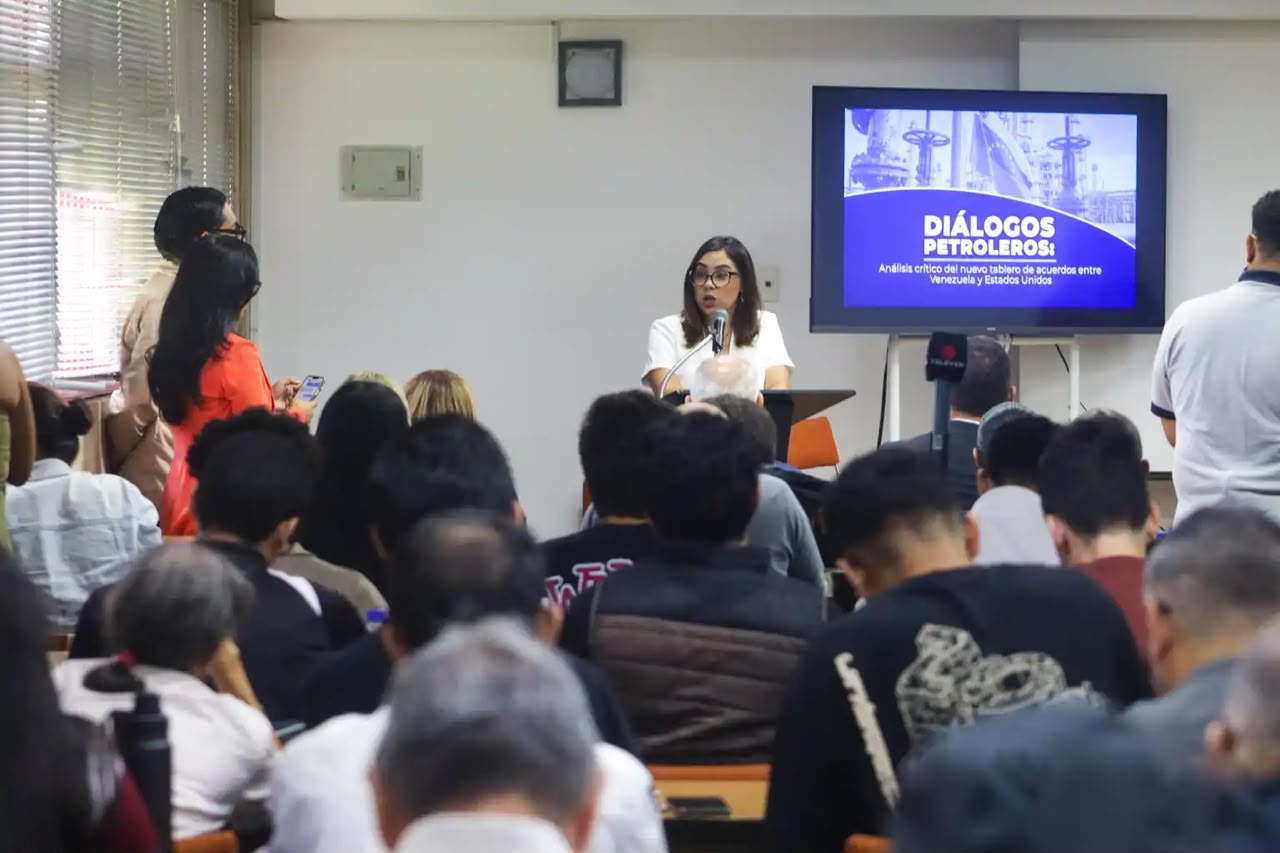
“At a time of uncertainty, when opacity is truly what prevails, when we do not have clear, official and formal information about the deals surrounding the hydrocarbon value chain, what really concerns us is becoming better informed, in a much more technical way, so that we can conduct a critical analysis,” she said during a forum held at the Central University of Venezuela (UCV).
The warning takes on particular relevance given the scale of the agreement announced on Aug. 28 by U.S. President Donald Trump and subsequently detailed by the White House. According to official U.S. information, Venezuela granted North American Blue Energy Partners (NABEP) 100-year concessions to develop 17 oil fields with proven reserves of approximately 65 billion barrels.
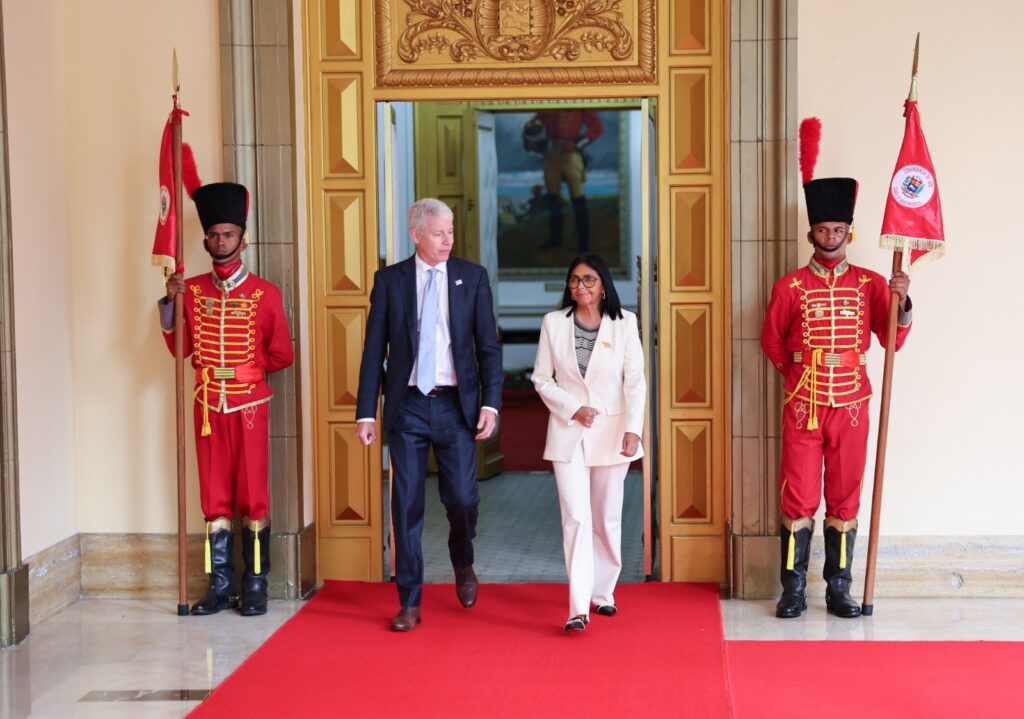
U.S. Energy Secretary Chris Wright visits Caracas after the oil agreement is announced.
The U.S. government also says that its Department of War will acquire a 35% equity stake in NABEP’s parent company. At the same time, the State Department will have the right to purchase, at production cost, 20% of the output from the company’s current and future fields. Washington will also have a right of first refusal over the remaining 80% and veto power over appointing members of the company’s board of directors.
Trump presented the pact as “the largest oil deal in history,” and it could hardly be otherwise, since the agreement gives his administration control over one-fifth of Venezuela’s proven crude oil reserves.
On the Venezuelan side, acting President Delcy Rodríguez has said the agreement provides more than $100 billion in investment and, unlike the figures provided by the White House, that its implementation period is 25 years.
Campos puts this discrepancy, along with other gaps in the available information, at the center of the discussion.
“There is no way to conduct a critical analysis if we do not actually have the information,” she said.
The official information provided so far does not amount to publication of the full contract. The constitutional lawyer emphasizes that distinction.
“The only thing we can know is that the contract, the agreement, PDVSA and a U.S. company signed the contract, but we do not know the technical matters, the technical details contained in the contract,” she said.
Among the questions she considers unresolved are the conditions for technology transfer, as well as labor commitments and the actual benefit for Venezuela.
“We do not know the technical terms for transferring technology to Venezuela. What are the labor terms that would apply to Venezuelans, and what benefit could this agreement actually bring to the nation?” she asked.
A National Assembly with restricted powers
The debate over parliamentary oversight does not stem solely from the agreement with the United States. The reform of the Organic Hydrocarbons Law, published in January 2026, substantially changed the National Assembly’s role in creating joint ventures.
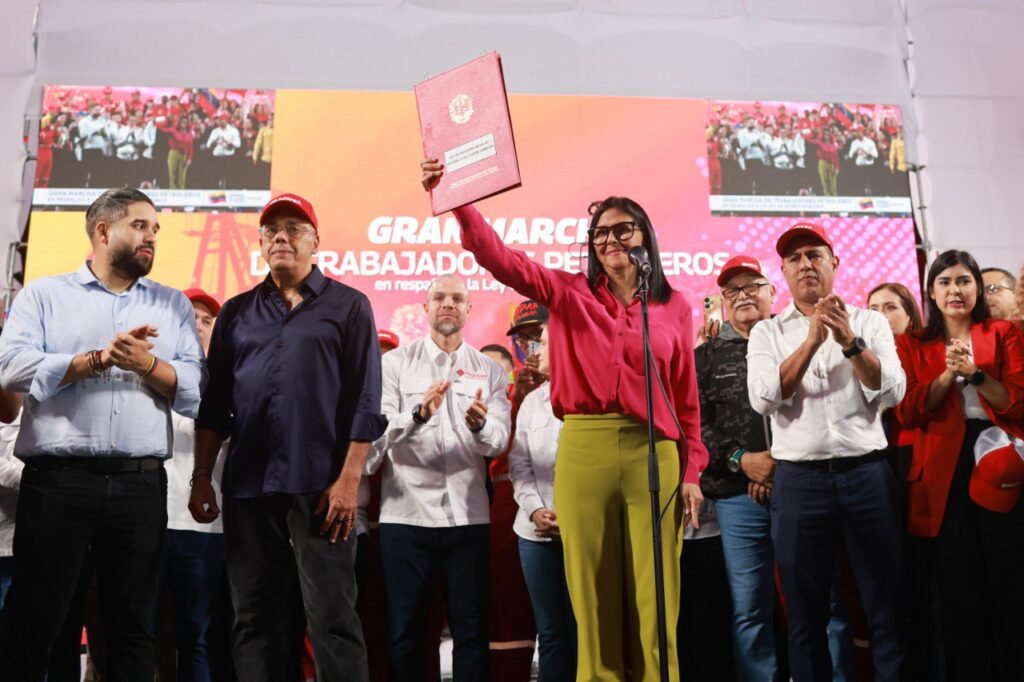
Delcy Rodríguez during the enactment of the reform of the Organic Hydrocarbons Law.
The new legislation establishes that the President authorizes the creation of these companies and the conditions for carrying out primary activities, and then reports them to the National Assembly so it can exercise its parliamentary oversight function. The previous regulations required prior approval from the Legislative Branch.
Campos considers this change fundamental to understanding the current debate.
“As we can see in the recently approved text, parliamentary approval of these contracts is not required,” she said.
The lawyer recalled that Article 150 of the Constitution provides for two scenarios involving contracts of national interest: those whose parliamentary approval depends on what the law establishes, and those entered into with foreign states, entities or companies not domiciled in Venezuela, which require authorization from the National Assembly.
The problem, in her view, is that the legal reform changed the scope of the first scenario and shifted the discussion from prior authorization toward a mechanism of notification and subsequent oversight.
“That is the major problem,” Campos said, referring to the loss of parliamentary oversight’s automatic nature.
However, for the professor at Andrés Bello Catholic University (UCAB), this does not mean that Parliament has lost all of its powers.
“Does this mean that the National Assembly loses the technical rigor to oversee everything established throughout the hydrocarbon value chain or anything related to PDVSA, joint ventures or participation contracts? Of course not,” she said.
On the contrary, she believes that parliamentary oversight takes on particular importance during the implementation of these deals.
“Parliamentary oversight does not end with approval, but extends to implementation and accountability for what the agreement contains,” she said.
Discretion as a new pressure point
The 2026 oil reform opened the door to greater private participation in primary activities, but it also introduced contracting mechanisms different from ordinary public procurement procedures. Joint ventures were excluded from the scope of the Public Procurement Law, although the legislation requires them to implement transparent contracting mechanisms.
For Campos, this is one area that requires greater public scrutiny.
“Public bidding used to be the norm in Venezuela, the ordinary procedure, and direct awards occurred only under very exceptional circumstances,” she explained.
The university professor recalls that, beginning in 2017, the approval of the so-called “Anti-Blockade Law” paved the way for the institutionalization of direct awards.
Since then, a couple of questions have repeatedly arisen: “Why are certain companies considered for contracts with PDVSA while other companies are definitely not considered? Why do some players enter into negotiations within the hydrocarbon value chain while other people do not?”
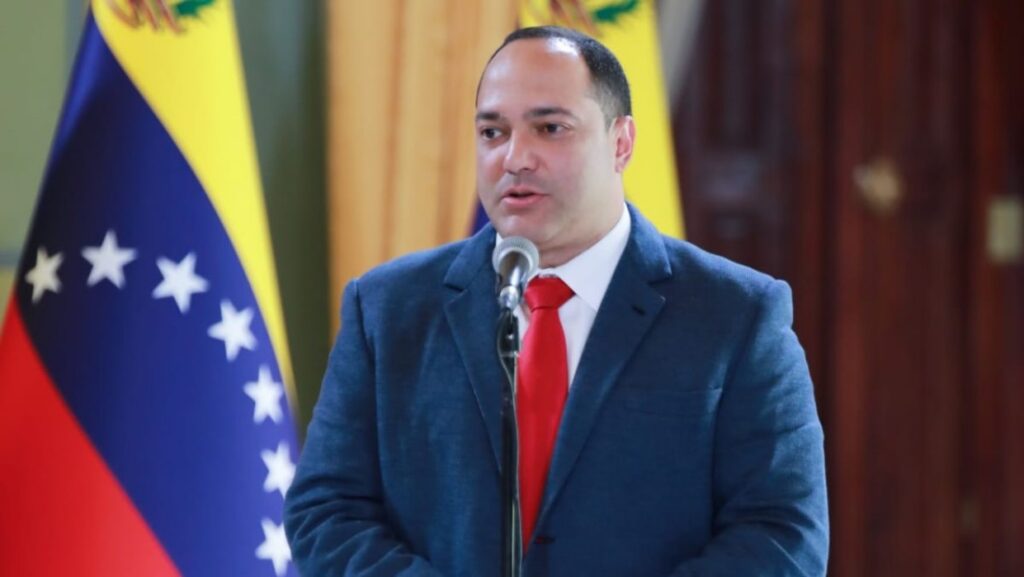
PDVSA President Héctor Obregón during the signing of memoranda of understanding with multinational oil companies.
According to Campos, the problem also extends to the economic terms of the contracts.
“A high degree of discretion can be observed on the part of the Executive, through the ministry responsible for hydrocarbons,” she said, referring to the royalty and tax regime.
The lawyer cited as an example the possibility that the effective royalty rate could stand at around 16%, compared with a legal ceiling of 30%, and raised the need to know which technical criteria determine a rate at that level.
“Under what technical assumption is it determined that the royalty should be almost half the ceiling established by law?” she asked.
The question is particularly relevant in an agreement that, according to public announcements, involves tens of billions of barrels in reserves and commitments that could extend for decades.
The tension between two legal frameworks
Another element that adds complexity is the interaction between Venezuelan law and the authorizations issued by the United States.
In August, the U.S. Treasury Department’s Office of Foreign Assets Control (OFAC) amended several licenses related to Venezuela, including authorizations for oil operations, transactions involving PDVSA, and activities by specific companies in the sector.
The architecture of these licenses is relevant because U.S. companies are subject to the restrictions and authorizations of U.S. law, even when their operations take place in Venezuela.
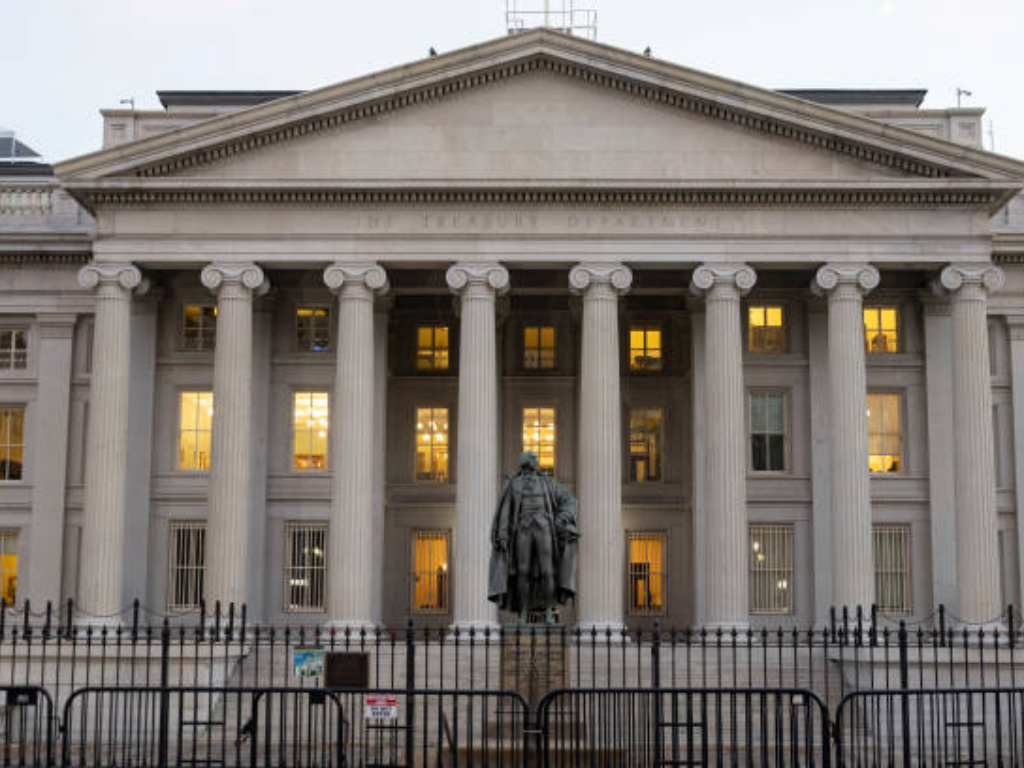
U.S. Department of the Treasury headquarters in Washington.
Campos identifies an antagonism there: “There is a tension between Venezuelan law as established in the Constitution and the Organic Hydrocarbons Law, and the licenses issued by OFAC,” she said.
The problem extends to the jurisdiction applicable in disputes. According to the legal scholar, Venezuelan law establishes national courts as the first instance for resolving disputes, with international arbitration as a subsidiary mechanism.
“In Venezuela, that is the jurisdiction established to resolve disputes,” she said.
The issue once again comes back to the contract, which still has not been published in full: without knowing its clauses on jurisdiction, arbitration, guarantees, tax obligations, and dispute-resolution mechanisms, it is impossible to establish precisely how a potential conflict between the agreed terms and Venezuelan law would be resolved.
National interest?
While the 1961 Constitution established that contracts of public interest could not be entered into without approval from the former Congress, the 1999 Constitution introduced a significant change: the National Assembly would approve these types of contracts “in the cases determined by law.”
This nuance is decisive, particularly in the hydrocarbon sector.
“Venezuela, our political and economic history, is marked by oil,” Campos recalls.
The constitutional lawyer maintains that the discussion over whether the agreement with the United States constitutes a matter of national interest should not be reduced to the volume of reserves involved.
“If that is not a matter of national public interest, then the discussion is over, because there is nothing more important in Venezuela than the discussion about oil.”

For the professor, the current problem is not simply defining whether the agreement constitutes a contract of national interest, but determining how far Venezuelan institutions’ ability to oversee its implementation extends.
“Of course it is a contract of national interest. The problem we have now is that the Constitution — itself — emptied that provision of substance by telling the law ‘when it so provides,’” she said.
In this context, the oil agreement announced by Washington tests the sector’s new governance model.
The January reform reduced Parliament’s prior involvement in creating joint ventures; the new legislation allows greater private participation; the Executive has broad powers to authorize contractual terms; and the United States has incorporated its own requirements through OFAC licenses.
That is why Campos considers the lack of information anything but a secondary issue.
“We have an important task of exercising public oversight,” she said. And that oversight, she added, also falls to the National Assembly.
While Washington presents the oil agreement as an operation that secures U.S. access to tens of billions of barrels and as a mechanism to restore Venezuela’s oil industry, the domestic debate remains open over the rules under which those rights were granted and the mechanisms available to ensure that the country’s interests prevail.
The answer largely depends on documents that are still not available to the public.