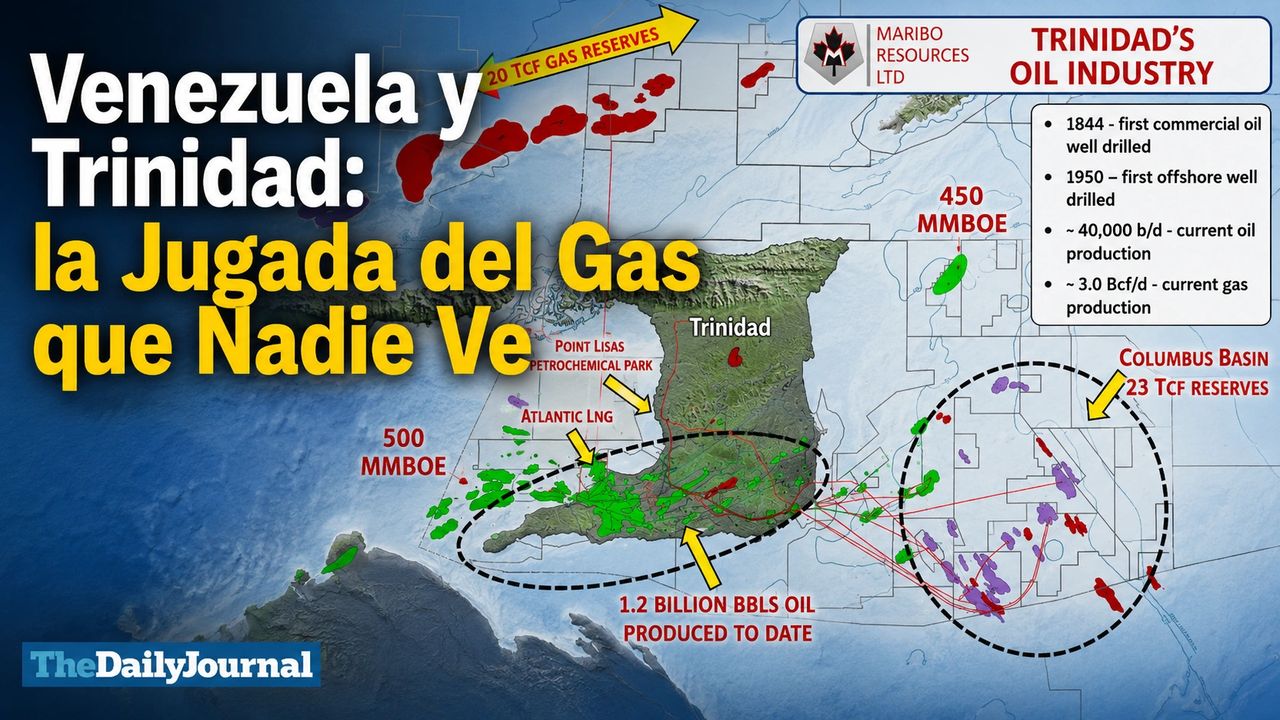
By Julio A. López, Editor-in-Chief — In an exclusive interview with The Daily Journal, Dr. Evanán Romero, Venezuela’s former deputy minister of Energy and Mines and a key figure in the country’s oil-sector opening during the 1990s, explained why the natural gas partnership between Venezuela and Trinidad and Tobago could become the region’s most profitable—and least understood—energy venture.
This interview is part of a podcast that The Daily Journal will publish on its social media platforms next week.
Romero explained that Venezuela and Trinidad and Tobago share two major natural gas fields in the Caribbean Basin: Loran-Manatí and Manakin-Cocuina. According to him, these fields represent the only realistic option for keeping Trinidad’s Atlantic LNG liquefaction complex operating, as the country’s own gas reserves continue to decline rapidly.
“Building a liquefied natural gas complex in Venezuela would cost between $10 billion and $11 billion today. Who is going to finance that if we have no sovereign credit?” Romero asked, arguing that Venezuela should capitalize on the infrastructure already built in Trinidad instead of duplicating it at home.
His reasoning aligns with the assessment of international experts. According to the Center for Strategic and International Studies (CSIS), Trinidad plays a crucial role in Venezuela’s ability to supply natural gas to global markets because of its geographic proximity and its established liquefied natural gas export facilities. Atlantic LNG itself currently operates below capacity. Although the complex has an installed capacity of 15.5 million metric tons per year—reduced to 12 million because of insufficient gas supplies—it shipped fewer than 9 million metric tons last year.
Another important field contains an estimated 4.2 trillion cubic feet of natural gas in shallow waters between 100 and 125 meters deep, with minimal geological risk. Shell operates the project alongside Trinidad’s state-owned energy company under a 30-year license. Nicolás Maduro halted the project in October 2025, but Venezuela’s political transition prompted Trinidad to revive discussions. A Trinidadian delegation traveled to Caracas to meet with Venezuelan officials regarding the Dragon project, while Trinidad’s state energy company is evaluating the reactivation of Atlantic LNG’s first liquefaction train, which has remained idle for years, amid geopolitical uncertainty stemming from the war involving the United States, Israel, and Iran.
At the same time, Shell continues advancing work at Loran-Manatí, the field Romero described as the most significant because of its size. The Manatí field, on Trinidad’s side, contains approximately 2.7 trillion cubic feet of gas, while the Loran field, on the Venezuelan side, holds about 7.3 trillion cubic feet. Shell aims to produce first gas from the shared field in 2027 and has already expanded the capacity of the pipeline that will transport gas to Trinidad to 1 billion cubic feet per day, up from the 700 million cubic feet originally planned.
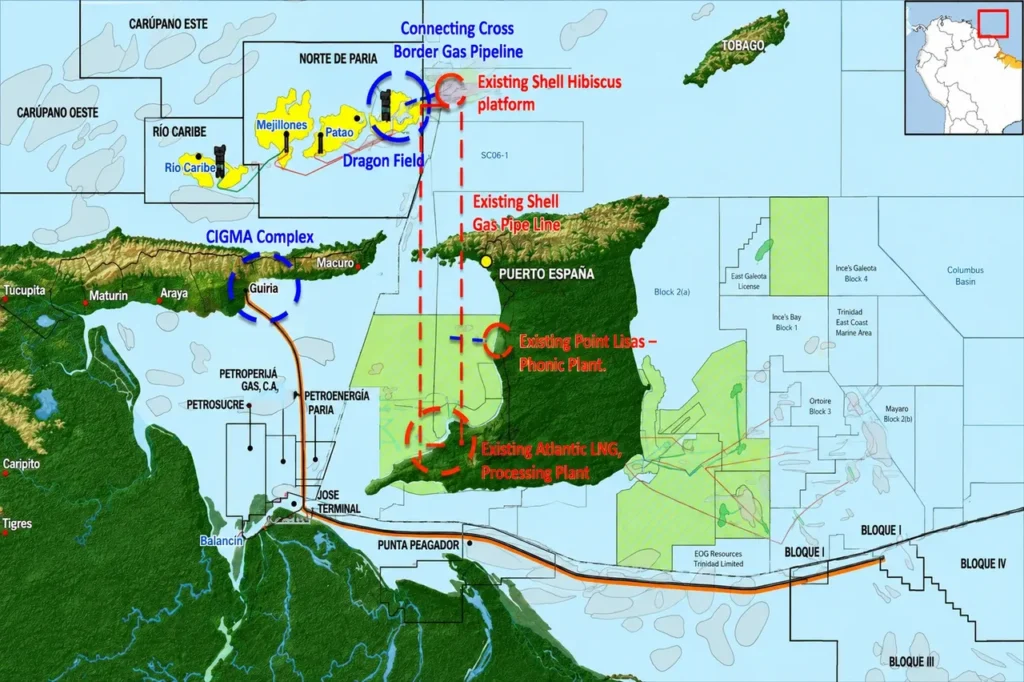
Romero also highlighted an important distinction within Venezuela’s legal framework. While gas associated with oil production falls under the Hydrocarbons Law, non-associated gas fields—such as Perla, Dragon, and Loran—operate under the 1999 Gas Law. He described that legislation as “more favorable” from a fiscal standpoint and argued that it explains why the legal framework “has remained in place throughout 28 years of Chavista rule without anyone challenging it.”
Discussing the Manakin-Cocuina block, Romero recounted how Chevron transferred its stake to PDVSA in exchange for oil assets in the Orinoco Belt, leaving Shell as the lead operator. Based on the figures he cited during the interview, Trinidad retains only a 26.94% interest in the Loran-Manatí block, while PDVSA controls the remaining share.
For Romero, the equation is straightforward: Venezuela has the gas; Trinidad has the infrastructure and the market.
“It’s the best possible business,” he concluded, estimating that the Loran-Manatí field alone could sustain approximately 15 years of joint production.