Julio A. López, Editor-in-Chief .— Liquefied natural gas (LNG) — pipeline gas cooled to -162°C to enable transportation aboard specialized LNG carriers — has become the most sensitive gauge of the global energy crisis. Only three regions produce LNG at industrial scale: the United States, Qatar, and Australia. That concentration explains why any disruption in the Middle East immediately reverberates across global markets.
Demand Doubled in Six Years
Global LNG demand doubled in just six years, driven by the loss of Russian pipeline gas supplies to Europe following the invasion of Ukraine and Asia’s accelerated industrial expansion.
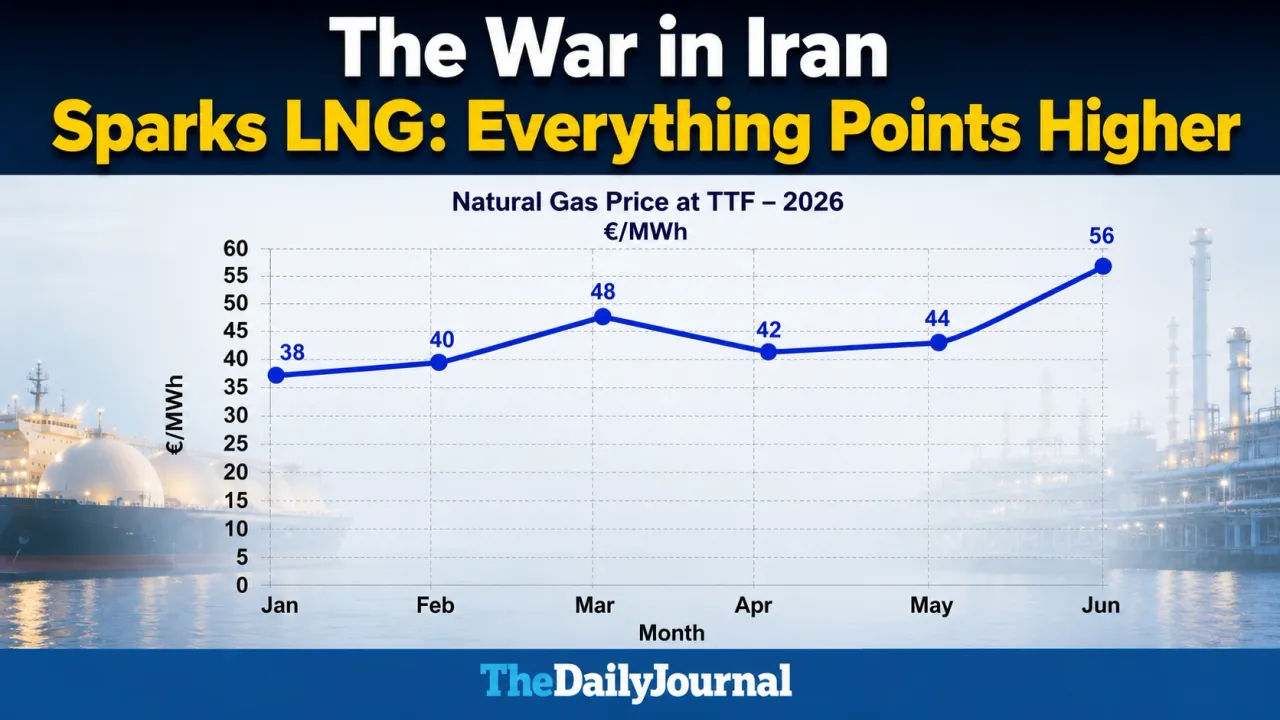
Against that backdrop of an already tight market, the so-called “Battle of Hormuz” — the military escalation between the United States, Israel, and Iran that led to the partial closure of the strait and missile strikes against Iranian infrastructure — pushed Brent crude above $85 per barrel and sent natural gas prices higher worldwide.
According to data compiled by industry analysts, Asian gas prices doubled in the week following the initial attacks, while European prices remained between 48% and 62% above February levels.
Morgan Stanley projects that Asian LNG prices could reach $25 per million British thermal units (MMBtu) in the third and fourth quarters of 2026, levels not seen in three years. Meanwhile, UBS estimates that the Japan-Korea Marker (JKM) will average around $17.50 per million British thermal units for the remainder of the year before easing toward 2027.
The Structural Damage: Qatar at the Epicenter
Beyond the immediate impact on prices, the conflict damaged critical infrastructure, including Qatar’s Ras Laffan facility — the world’s largest liquefaction site — delaying the expansion of Qatari capacity beyond 2026.
According to estimates cited by Infobae, restoring that lost capacity could leave the global market facing a cumulative shortfall of up to 40 million tonnes of Qatari LNG by year-end, equivalent to 10% of the global 2025 supply.
European gas inventories are also at their lowest seasonal levels in 15 years, while Europe and Asia compete for every available cargo.
Wall Street Winners: Venture Global and Cheniere
That scarcity has turned U.S. export terminals into the market’s most expensive — and profitable — lifeline for Europe.
Venture Global raised its fees by as much as 69% by capitalizing on the crisis, repeating a strategy it previously used during the 2022 energy crisis, when it sold spot cargoes while its facility was still officially under construction.
Analysts also point to Cheniere Energy as one of the major beneficiaries of instability around the Strait of Hormuz.
The Question That Will Define the Quarter
LNG carrier traffic through the Strait of Hormuz remains well below pre-war levels, and uncertainty continues to surround future trade flows.
The International Energy Agency expects global gas demand to decline by 0.5% this year — the third year-over-year contraction in seven years — precisely because of the higher prices resulting from tighter supply conditions.
As second-quarter results arrive, the market will determine which links in the LNG value chain deserve confidence and which do not: upstream producers, liquefaction terminals, cryogenic shipping companies, or destination regasification facilities.
The answer will emerge well by well, balance sheet by balance sheet, in the days ahead.