Luis Vilchez
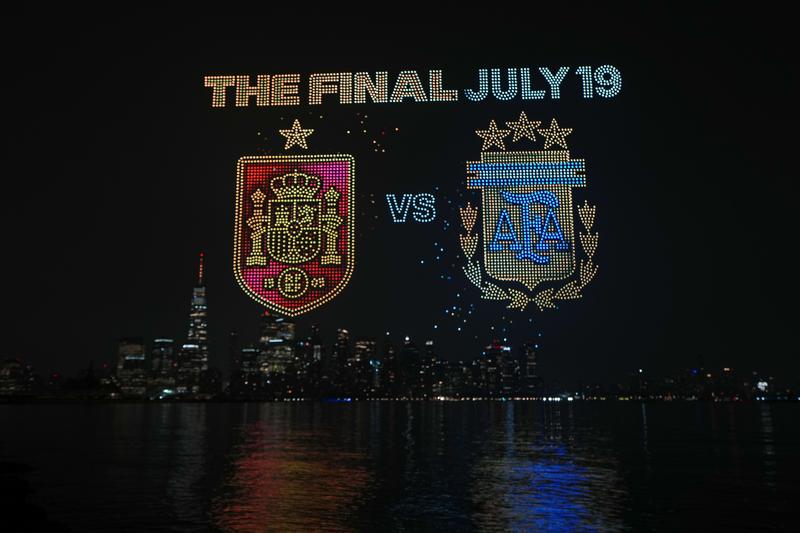
The clash of ideas has always shaped human history. The early 20th century witnessed World War I—and, decades later, World War II—against a backdrop of ideological and political conflict. Economics has long divided followers of John Maynard Keynes and Friedrich Hayek. Psychology has its own rivalry between Sigmund Freud’s psychoanalysis and B.F. Skinner’s behaviorism. Football is no exception. The 2026 FIFA World Cup final at MetLife Stadium in New Jersey will pit two distinct philosophies against one another: Spain, the standard-bearer of positional play, and Argentina, the leading advocate of relational football.
How can positional play be defined? It is the rational occupation of space on the pitch to create numerical advantages that lead to scoring opportunities. Its strengths include protection against losing possession, control through sustained ball possession, and the creation of automated patterns of play. On the other hand, it leaves less room for individual creativity, opponents have studied it extensively, and it demands technically gifted players who can combine effectively.
Relational football—also known as functional football—can be described as players gathering around the ball and treating it as the center of every interaction, while fulfilling specific roles such as support, runs, or defensive cover around the ball carrier. This approach creates more unpredictable attacking patterns, encourages creativity, and strengthens the chemistry between teammates. At the same time, it carries greater risks when out of possession, depends heavily on player partnerships, and requires outstanding technical quality in tight spaces.
Positional football functions as a collective mechanism in which every player becomes part of a larger structure, following predefined guidelines that shape decisions until they become instinctive. The goal is not to turn players into robots, but to free them from constantly having to think about routine actions so they can focus on solving more complex situations. European football has embraced this model, although many teams at this World Cup have struggled against highly organized defensive blocks that have limited their attacking effectiveness. Players raised under this more academic model often rely more heavily on their coach’s instructions.
The beauty of relational football lies in the fact that it resembles a living organism more than a mechanism. Players build it from within, while the coach exerts less influence over what unfolds on the field. This philosophy gives footballers the freedom to take initiative and solve problems through individual inspiration, overcoming the uncertainty of a sport that Argentine journalist Dante Panzeri famously described as the “dynamics of the unthinkable.” Creativity, rather than tactical diagrams, provides most of the answers. This more spontaneous, street-inspired style of football unleashes moments of magic that can break down compact defensive structures. Argentina and Colombia have become its leading exponents during this 2026 tournament.
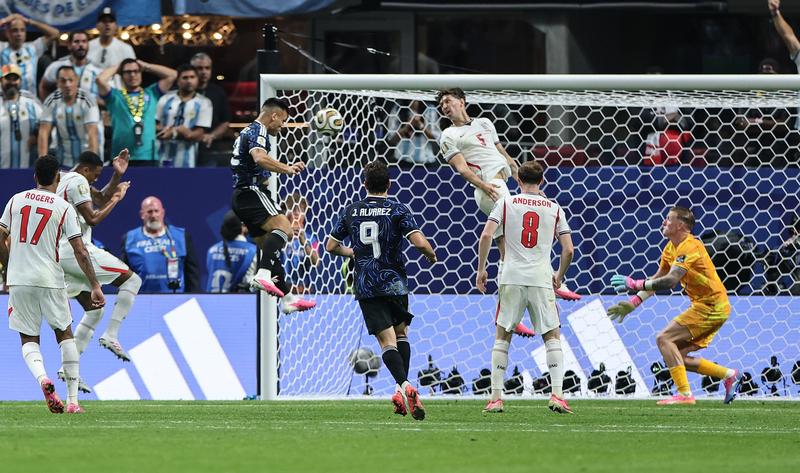
Lautaro Martínez (3rd L) of Argentina celebrates after scoring during the semifinal against England at the 2026 FIFA World Cup in Atlanta, United States, July 15, 2026. (Xinhua/Cao Can)
A new identity versus rediscovered roots
Older generations remember Spain as La Furia Roja (The Red Fury). Younger fans, however, identify the national team with tiki-taka. That transformation began under Luis Aragonés and traces its symbolic birth to October 13, 2007, in Denmark. Sergio Ramos scored the winning goal after a move that lasted one minute and fifteen seconds, featuring 28 passes and 65 touches of the ball.
That style transformed Spanish football. Before then, Spain had won only one European Championship, in 1964. Since then, the team has captured three European titles—in 2008, 2012, and 2024—lifted the 2010 FIFA World Cup, and now stands one victory away from winning another world title in New Jersey.
The change stemmed from Spain’s physical limitations. German, Italian, and French teams generally possessed greater size and strength. Luis Aragonés explained that reality to El País:
“The process that led us to our final style came through the natural selection of players. We didn’t have the physical qualities to run or battle for 90 minutes, but we did have the ability to pass.”
Spain turned a weakness into its greatest strength, putting an end to the debate surrounding Raúl González Blanco’s exclusion from the squad.
The expression tiki-taka first appeared in conversations between Mundo Deportivo and Espanyol manager José María Maguregui during discussions of full-pitch training sessions. The phrase gained wider recognition after Athletic Club manager Javier Clemente used it mockingly before a European Cup match against Bordeaux.
“Bordeaux doesn’t impress me much. I think they’re one of the teams we could beat in the European Cup, even if they form the core of the European champions. I watched them last year and admit they have an excellent team with players like Tigana, Giresse, Lacombe, and now Chalana. But I don’t like the French style of football. They play a tiki-taka style that doesn’t appeal to me, and I believe we can counter it.”
Journalist Juanma Trueba later recalled the remark, which ultimately backfired after Athletic fell to the French side.
Tiki-taka belongs to the broader philosophy of positional play, whose most influential figure remains Pep Guardiola. Paris Saint-Germain manager Luis Enrique, fresh off back-to-back UEFA Champions League titles, represents its current highest expression.
Argentina followed a different path. Rather than reinventing its identity, Lionel Scaloni guided the national team back to its footballing roots. Early in his tenure, he sought a more vertical, physical style inspired by France’s 2018 World Cup-winning team. Eventually, however, the coach from Pujato embraced La Nuestra, the classic South American identity that carried Argentina to the World Cup title in Qatar.
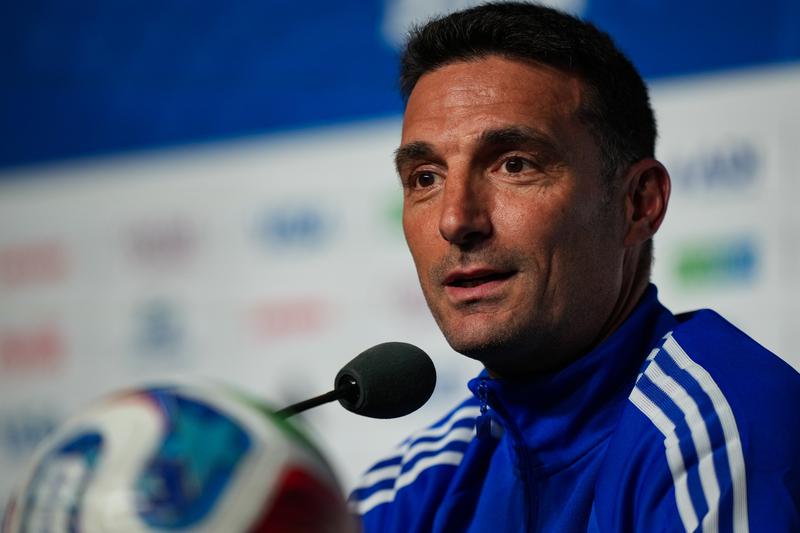
Lionel Scaloni, head coach of Argentina, attends a press conference ahead of the Round of 16 match against Egypt at the 2026 FIFA World Cup in Atlanta, United States, July 6, 2026. (Xinhua/Chen Yichen)
“We are an extremely football-loving country. We clearly have what we call La Nuestra, which is a blend. We are not Brazil, with its dazzling style, nor Uruguay, with its more combative characteristics. We exist somewhere in between. We have our own identity, and at the national team level, you can clearly see it. Every country and every culture leaves its own imprint.”
Pablo Aimar offered that explanation in 2024. The former River Plate midfielder serves on Scaloni’s coaching staff.
That philosophy emerged as a rebellion against the long-ball game and physical battles introduced by English football at the beginning of the twentieth century. Dribbling, precise passing, pauses, and deception all grew out of neighborhood pickup games—the potrero, as Argentines call them.
Sociologist Eduardo Archetti, a pioneer in the anthropology of football and author of Style and Masculine Virtues in El Gráfico: The Creation of the Argentine Football Imaginary (1995), described it this way:
“People will say Argentines do not simply ‘play football’; they ‘perform football,’ like virtuosos playing the piano or the violin. A great team resembles an orchestra made up of outstanding individual talents. The hallmark of Argentine football becomes the touch of the ball—short, quick passing.”
Rediscovering that identity allowed Argentina to end a title drought of more than two decades by winning the 2021 Copa América, its first major trophy since 1993 despite generations of exceptional talent. The team defended the continental title in 2024 and added a third World Cup star in Qatar in 2022.
On Sunday, July 19, Argentina has the opportunity to equal Germany and Italy with four World Cup titles, trailing only Brazil’s five. In New Jersey, the match will crown not only the next world champion, but also the footballing philosophy that may shape the sport for years to come: the complete triumph of relational football or the resurgence of positional play.