By Héctor Sánchez, Sociologist — Let us imagine, for a moment, the following scenario: the U.S. midterm elections arrive, and Donald Trump suffers a crushing defeat, just as opinion polls suggest amid dissatisfaction from six out of every 10 Americans. Under those circumstances, the president would most likely face immediate impeachment proceedings.
Given Washington’s status as a global power, the political shockwaves would reverberate across the world. In Venezuela, however, the consequences would take on the character of a peculiar tragicomedy. That raises an unavoidable question: how would our political leadership—both the government and the opposition—respond?
This is no trivial question. After the turbulent events of January—marked by the violation of national sovereignty, the kidnapping of Nicolás Maduro, and the installation of an interim government—both factions surrendered to Washington’s dictates.
Every day we witness a competition in submission. The government and the opposition compete to prove who can implement the “three-phase plan” (stabilization, recovery, and transition) more effectively—a roadmap designed entirely in Washington that now guides every move of Venezuela’s political class. The question remains: if power changes hands in the United States, would these actors rediscover the meaning of sovereignty, or would they simply rush to see who can kneel most gracefully before the next occupant of the Oval Office?
This posture does not stem from a miscalculation; it reflects a deliberate method. While the interim government surrenders sovereignty through legal reforms in strategic sectors such as oil and mining under foreign oversight, the opposition limits itself to criticizing the process for moving too slowly. In essence, it has become an audition for vassalage.
Ironically, while our political elite clings to the CIA’s “declassified” documents that Trump uses to denounce alleged conspiracies—such as claims of election hacking through Smartmatic—U.S. intelligence experts themselves caution that the evidence remains limited, lacks conclusive proof, and often serves as a tool of domestic disinformation.
Yet an even more troubling possibility exists: what would happen if Trump refused to recognize the election results or suspended the vote by invoking national security? This is not an unfounded hypothesis. The president has already begun laying the groundwork to challenge the electoral process by casting doubt on the system’s integrity, removing the leadership of the U.S. Election Assistance Commission, and promoting legislation such as the SAVE Act to restrict voting. Analysts warn that Trump seeks not only to win, but also to consolidate absolute control over his party and turn it into a shield for his own political survival, even at the expense of public confidence in America’s democratic institutions.
Faced with the possibility of an authoritarian drift in the self-proclaimed “cradle of democracy,” one must ask: will Venezuela’s elite—politicians, business leaders, and influencers—continue to subordinate themselves blindly to a system that is dismantling its own institutional checks and balances? Will our ruling class find even a trace of dignity and remember that sovereignty is not a commodity to be negotiated?
Clear answers prove elusive when political identity rests on convenience rather than principles. Our leaders present themselves as guardians of the people to justify their place in power. At the same time, the “higher interest” they claim to defend amounts to nothing more than their own political survival.
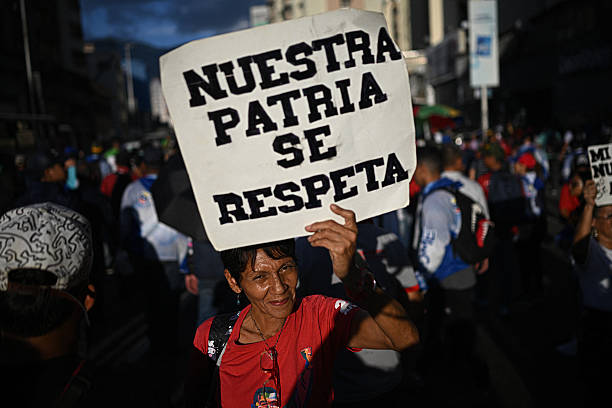
But this political class overlooks one essential fact: the Venezuelan people are not a flock. We are neither minors nor incapable citizens in need of foreign guardianship. We are a society that has endured hyperinflation, meager wages, sanctions, blackouts, disastrous governments, and even natural disasters and earthquakes. Through those hardships, we have learned to organize ourselves and recognize one another beyond the banners others have imposed upon us.
These years of crisis have left us with one fundamental lesson: original political power does not reside in Miraflores, nor in the U.S. diplomatic institutions that now extend their influence through the American embassy and other instruments of power. The strength of the Venezuelan people lies in their daily resilience and in the dignity of those who refuse to break. While the political establishment kneels before a Washington consumed by its own internal conflicts, the people remain standing.
Ultimately, whether Trump remains in power or falls should amount to little more than an anecdote for us. The real question is not what our political leaders will do—they have already demonstrated their willingness to serve foreign power—but what we ourselves will do.
The solution to our crisis will not come from those who compete to become the most loyal vassal. It will come from ordinary citizens who understand that the highest interest belongs to a people firmly determined not to accept tutelage, manipulation, or betrayal.