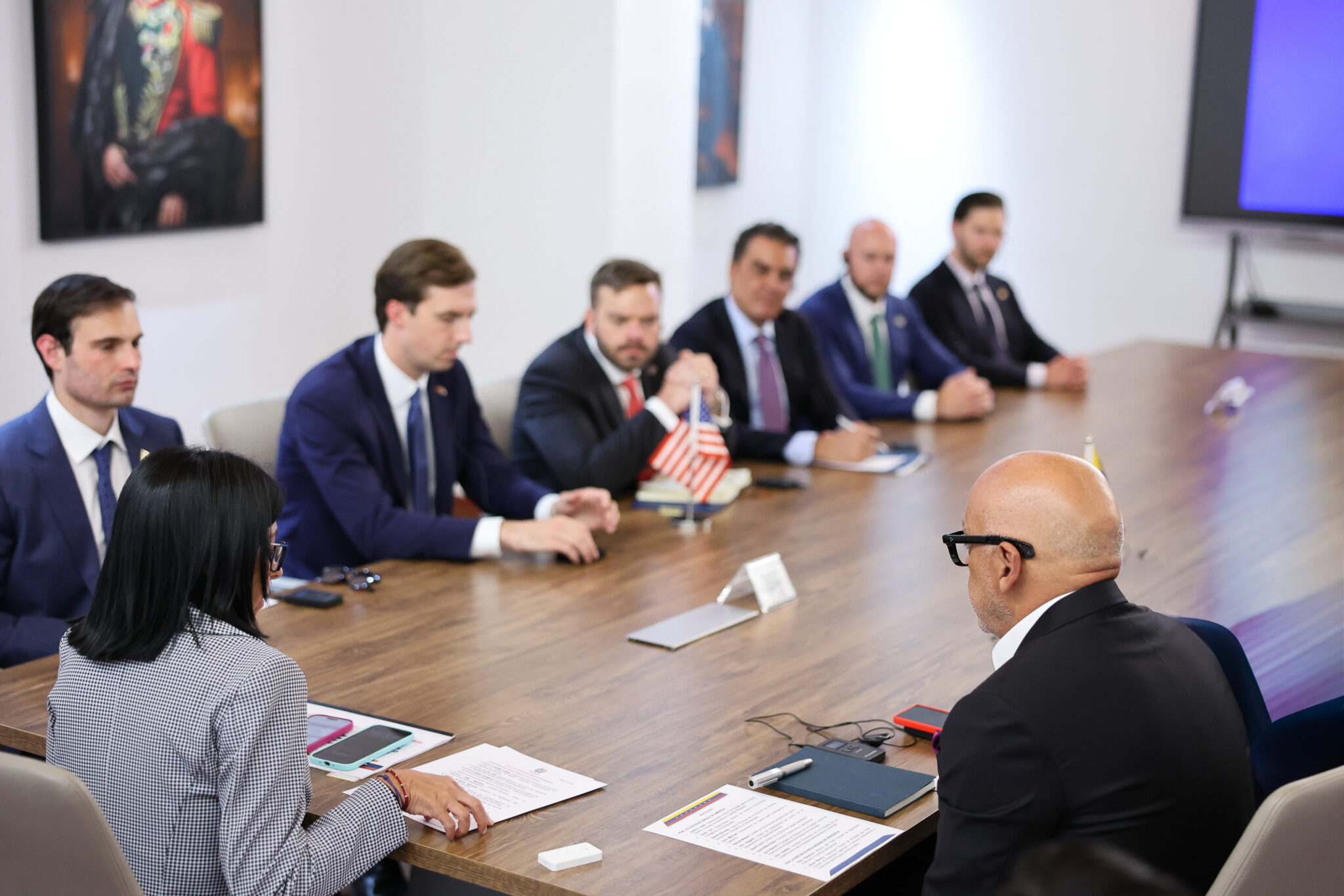
The Daily Journal. — Caleb Orr, the U.S. Assistant Secretary of State for Economic, Energy, and Business Affairs, met with Acting President Delcy Rodríguez in Caracas on Wednesday. Two weeks earlier, members of the U.S. Congress questioned Orr about the management of revenue generated from the sale of Venezuelan oil.
Caracas announced that Rodríguez held a working meeting with a “high-level delegation” from the U.S. government. However, the Venezuelan government did not identify the delegation’s members or specify the positions of the other officials in attendance.
According to the official statement, the participants discussed the response to the twin earthquakes of June 24, as well as energy cooperation, investment, and security.
“We reaffirmed the importance of continuing to advance a shared agenda for the benefit of our peoples,” Rodríguez wrote on social media, alongside photographs of the meeting.
Spanish newspaper ABC reported that, in addition to Orr, the delegation included Jeremy Lewin, a member of the White House National Security Council, and John Barrett, the U.S. Chargé d’Affaires in Caracas, along with other State Department officials.
Orr faced questions in Congress
Orr’s visit to Caracas came shortly after his appearance before the U.S. House of Representatives.
On July 14, the official testified before the House Foreign Affairs Committee during a hearing on commercial diplomacy.
Lawmakers held the hearing amid growing concerns in Washington about the management of revenue from Venezuelan oil exports.
Republican Representative María Elvira Salazar questioned Trump administration officials about the safeguards in place to prevent Venezuelan oil revenue from returning to opaque management and asked how authorities were handling the funds generated by oil sales.
The questioning carried particular significance because Orr oversees U.S. economic and energy policy toward Venezuela.
Since February, Orr has also publicly supported the participation of U.S. companies in Venezuela’s economic recovery. Referring to the country’s mineral resources, he said Venezuela represents a “great opportunity” and added, “We want Venezuela’s critical minerals to generate revenue for the benefit of the Venezuelan people.”
More than $13 billion from oil
The meeting in Caracas also took place as controversy continues to grow over the revenue generated by Venezuelan oil since the U.S. military operation on January 3 and the subsequent changes to the sanctions regime.
International media estimates place this year’s revenue from Venezuelan oil sales under the Washington-administered framework at more than $13 billion. The Financial Times reached that estimate by analyzing export volumes and international crude prices.
President Donald Trump referred to that figure on Monday and said the United States had generated even more than $13 billion.
“Thirteen billion dollars from Venezuela? I think it’s even more than that,” Trump told reporters aboard Air Force One.
When reporters asked where the money was, the president replied that the funds “go toward the administration of the country.”
Oil and reconstruction on the agenda
The meeting between Orr and Rodríguez once again placed oil at the center of relations between Caracas and Washington.
In June, Orr said Venezuela’s oil industry was recovering according to the Trump administration’s plans and described relations with Caracas as part of a broader U.S. energy strategy for the hemisphere.
According to ABC, the discussions during the visit covered the management of oil revenue, Venezuela’s post-earthquake reconstruction, and the country’s opening to new energy investments.
The earthquake emergency remains one of the most urgent challenges facing Delcy Rodríguez’s administration. The World Bank recently estimated $19.6 billion in direct physical damage caused by the June 24 earthquakes. It warned that a slow reconstruction process could hinder Venezuela’s economic recovery over the next decade.
According to the Presidential Press Office, the agenda also included investment and security. However, Caracas did not announce any specific agreements or explain the mechanisms the parties will use to advance that cooperation.