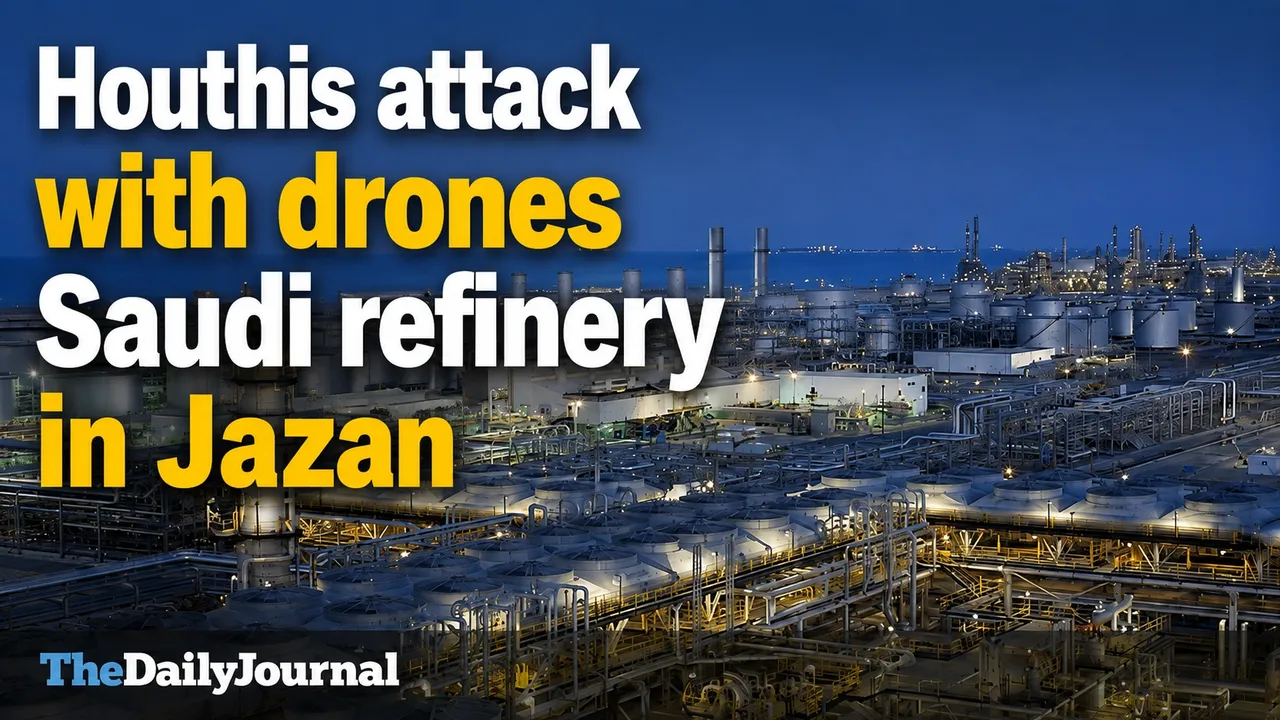
Julio A. López, Editor-in-Chief.— Yemen’s Iran-aligned Houthi movement claimed responsibility on Sunday for a new drone attack on Saudi Aramco’s refinery in Jazan, just two days after Saudi Arabia signed a defense pact with Turkey and Pakistan in response to growing regional instability stemming from the war between the United States, Israel, and Iran.
The Attack and the Confirmed Damage
Saudi Arabia’s Ministry of Energy confirmed that a fire broke out at the facility and was extinguished without casualties, although it did not specify its cause. Houthi military spokesman Yahya Saree posted on X that the group had used a drone to strike the refinery, which processes 400,000 barrels of crude oil per day in the kingdom’s southwest. According to sources cited by Reuters, the plant had already been shut down on July 27 for repairs following an earlier attack on July 25 and 26 that damaged the Integrated Gasification Combined Cycle (IGCC) complex—which supplies power, steam, and hydrogen—as well as the storage tank area. Operations had been expected to resume by mid-August.
It is important to distinguish between what has been verified and what has been claimed. It has been confirmed that a fire broke out at the Jazan refinery and that the facility sustained damage, and the Houthis’ claim of responsibility has also been verified. However, there is still no independent verification that the drone was the specific cause of Sunday’s fire. Aramco has acknowledged that the recent attacks have caused some production disruptions but maintains that they have not, so far, resulted in significant operational or financial damage.
In a separate statement, Saree said the Houthis had also launched missile and drone attacks against the Yemeni port of Mocha, on the Red Sea, which is controlled by the internationally recognized Aden-based government backed by Riyadh. Yemeni government sources said air defenses intercepted drones targeting the port’s commercial pier and storage facilities. The port is strategically important because it lies near the Bab el-Mandeb Strait, and its potential closure would deprive Saudi Arabia of an alternative route should the Strait of Hormuz remain blocked.
A New Military Alliance as a Regional Response
The escalation in attacks, which has disrupted global energy supplies and shaken the world economy, prompted Saudi Arabia on Friday to sign an alliance with two Sunni Muslim allies of the United States: Turkey and Pakistan. The pact is intended to strengthen collective deterrence against any act of aggression and stipulates that an armed attack against any one of the three countries will be considered an attack against all of them. Turkish Foreign Minister Hakan Fidan stated that the new alliance “is not directed against Iran or any other country,” but rather constitutes a general commitment to the security of all three allies. For now, it remains unclear whether—or how—Pakistan or Turkey would participate in any potential Saudi response to the latest attacks.
Context: A Blockade Declared One Month Ago
Last month, the Houthis declared a naval blockade against Saudi Arabia in the Red Sea, alleging that Riyadh had imposed a siege on them—an accusation Saudi Arabia categorically denies. Saudi Arabia’s Ministry of Energy described the attack on Jazan as “yet another assault on a vital civilian facility that serves citizens and contributes to commercial and maritime activity in the Red Sea.”
Negotiations Stall as Violence Continues
Iran and its allied Shiite armed groups have been attacking Saudi Arabia and other Gulf states, as well as disrupting their energy shipments, since the United States and Israel struck Iran on February 28, marking a major escalation after years of regional tensions. Talks between Washington and Tehran aimed at reaching a peace agreement have continued without a definitive outcome, with access to the Strait of Hormuz—a critical route for global energy supplies—remaining one of the principal obstacles. According to sources cited by Energy News Beat, Saudi Arabia is evaluating military options and limited responses while continuing to prioritize diplomacy and strengthen its regional alliances.