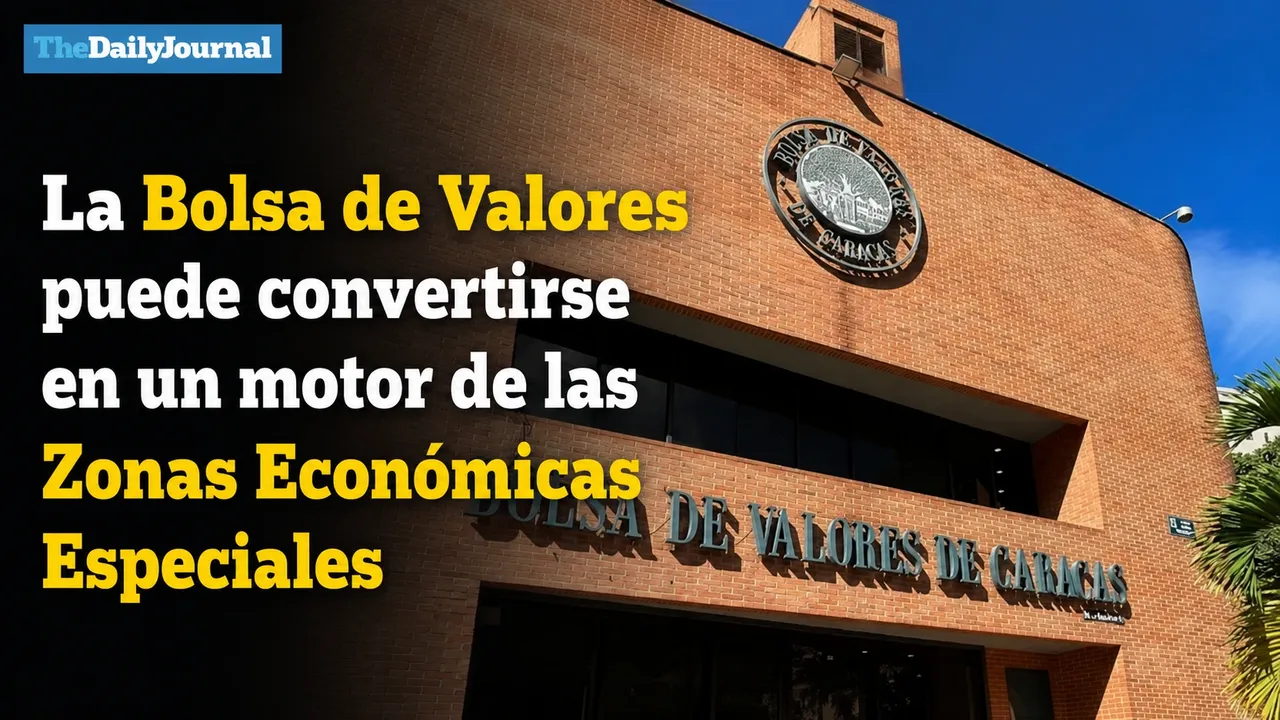
Julio A. López, Editor-in-Chief. Víctor Julio Flores Rojas, former president of the Caracas Stock Exchange, argues that Venezuela’s capital market can play a decisive role in financing Special Economic Zones (SEZs), channeling domestic and foreign capital into infrastructure, industry, technology and other productive sectors.
—How important can Special Economic Zones be for Venezuela?
—Special Economic Zones represent an important tool for attracting domestic and foreign investment, promoting industry and creating jobs. Latin America has extensive experience with free trade zones, development areas and special export regimes. In many of these models, capital markets serve as financing mechanisms through debt instruments, companies opening their capital to investors, and specialized funds.
—Does Venezuela currently have a legal framework that would allow it to move in that direction?
—Yes. Since July 2022, we have had the Organic Law on Special Economic Zones, which governs their creation, organization and development and establishes economic and tax incentives. We also have the Organic Law of the National Financial System and the Decree with the Rank, Value and Force of Law on the Securities Market. Coordinating these instruments provides a foundation for developing concrete proposals.
—What role should Venezuela’s capital market assume?
—We must move from expectation to action. My proposal is to bring together the National Chamber of Securities Market Intermediaries, the National Chamber of Securities Issuers, the Venezuelan Securities Depository and the National Securities Superintendency to hold a technical discussion. We have to integrate capabilities, experience, technology, and legislation to present the Executive Branch with proposals that can be implemented quickly. It is not about asking; it is about doing what we know best.
—What could the Stock Exchange specifically contribute to the development of the SEZs?
—The market can become a channel that connects business projects with domestic and foreign investors. Latin American experience shows that stock markets can mobilize resources through debt and equity instruments, as well as funds focused on infrastructure, real estate, logistics, technology and exports. That model offers important points of reference for Venezuela.
—You also propose tax changes. Which one do you consider a priority?
—A first step would be to extend the income tax exemption to private debt securities authorized by SUNAVAL and registered with the National Securities Registry and the Caracas Stock Exchange, taking Decree No. 5,127 of May 8, 2025, as a reference.
—What do you propose regarding VAT applied to market activities?
—Based on the principle of non-taxability established in Article 16, numeral 4, of the Value Added Tax Law, we propose excluding transactions and financial services provided by sector participants from this tax, including brokerage firms, securities firms, investment advisers and public securities brokers. This would help improve the competitiveness of the domestic market.
—Are there additional mechanisms to encourage companies to turn to the capital market?
—Yes. I also believe we should revive the principles that gave rise to Authorized Capital Corporations. We could establish a temporary, full or partial income tax exemption for resources allocated to strengthening the share capital of domestic companies that participate as issuers in the securities market.
—Would the ultimate goal be to turn the stock market into a more important source of corporate financing?
—That must be one of our major goals. Venezuela faces enormous investment and reconstruction needs. The securities market has the human talent, knowledge, and technological capabilities to help channel resources toward productive activity. We have the legal instruments; now we must coordinate and use them.
—You close your proposal by invoking the historical identity of Venezuela’s stock market. What does that idea mean to you?
—It means returning to our roots, to the Ceiba de San Francisco, and understanding that Venezuela’s stock market does not belong to any one person, nor does it identify with any individual. Its true image lies in those who work in a factory, support a household, run a company, cultivate the land, build, or work in hydrocarbons, manufacturing, or mining. It also lives in our students’ dreams and in our children’s future.