By María Alejandra Díaz
Venezuela is facing more than the physical consequences of the recent earthquakes. The deeper tragedy lies within its institutions: a country where the erosion of the State began long before the natural disaster, and where the emergency now threatens to become a pretext for deepening the constitutional void.
While images of destruction reveal damaged streets, collapsed homes, and devastated communities, another, less visible reality continues to unfold: the steady erosion of the institutions that should have responded to a crisis of this magnitude. Venezuela’s problems did not begin when the ground shook; they began when the Constitution ceased to serve as an effective limit on political power.
For many Venezuelans, July 5, 2026, marks a date that demands an honest confrontation with the country’s legitimacy crisis. The national emergency cannot serve as a justification for suspending democracy or indefinitely postponing the will of the people.
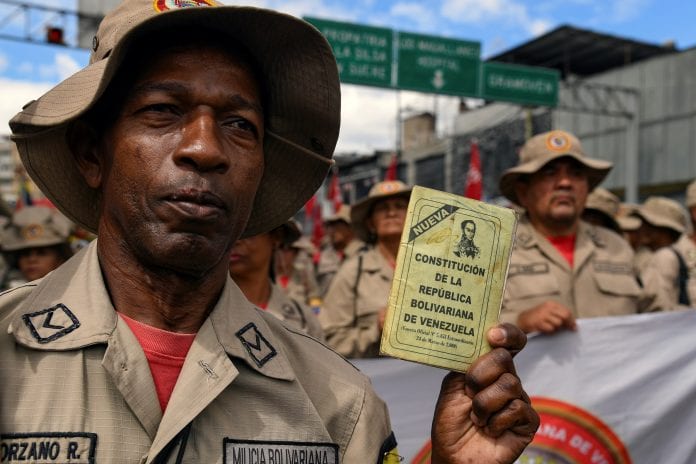
The Constitution establishes clear limits for states of emergency. Article 234 makes clear that the temporary absence of the President does not dissolve the constitutional order or authorize an unlimited concentration of power. On the contrary, constitutional guarantees become even more important in times of uncertainty.
Using an emergency to justify blocking democratic processes creates a fundamental contradiction: a constitutional State cannot respond to a crisis by dismantling the very rules that give it legitimacy. National reconstruction requires strong institutions, not permanent extraordinary powers.
The central question is not simply how to rebuild damaged infrastructure, but who holds the legitimate authority to lead that reconstruction. No society can regain stability if authorities whose legitimacy large segments of the population question make its most fundamental decisions.
The 1999 Constitution provides mechanisms to address presidential vacancies and institutional crises. When the institutions responsible for acting fail to fulfill their constitutional duties, the problem ceases to be merely political and becomes a legal crisis of enormous proportions.
The earthquake did not bring about the collapse of the Venezuelan State; it merely exposed a reality that already existed. The lack of institutional capacity, administrative weakness, and the loss of independence within public institutions all stem from a long process of weakening the rule of law.
A country does not lose its ability to respond overnight. Institutional decay unfolds gradually: when checks and balances disappear, when the separation of powers erodes, when public administration no longer serves its citizens, and when the Constitution ceases to function as the supreme law and instead becomes a tool of political convenience.
Venezuela cannot rebuild its future on a foundation of illegitimacy. The Constitution does not stand in the way of overcoming the crisis; it provides the very framework needed to restore public trust, organize an institutional transition, and ensure that the country’s future remains in the hands of its citizens.
The nation’s priority must be to restore a transparent democratic process, backed by electoral guarantees and institutions capable of representing the will of the people. The challenge extends far beyond rebuilding buildings, repairing roads, or addressing material emergencies. It requires rebuilding the social contract that sustains the Republic.
History offers a clear lesson: without a Constitution, no reconstruction can endure. A country may survive an earthquake, but it is far less likely to overcome a prolonged institutional vacuum.
July 5 should stand as a warning. Venezuela faces a defining choice: restore the full force of the constitutional order or allow exceptional rule to become the new normal.
Sovereignty belongs to the people. That principle cannot remain a mere declaration in the Constitution; it must become a political and institutional reality. Venezuela’s future will depend on the ability of its citizens and institutions to restore the rule of law before the vacuum of power becomes irreversible.
History also shows that societies do not resolve crises by suspending democratic principles. Venezuela needs a national agreement that places the Constitution back at the center of public life, restores its institutions, and opens a path toward reconciliation grounded in citizen participation. Only then will the country be able to transform today’s tragedy into an opportunity to rebuild the Republic on its democratic foundations.