By Wilmer Rosas
Specialized estimates indicate that Venezuela’s twin earthquakes of June 24, 2026, produced more than one million tons of rubble and debris. That presents an enormous challenge—and, at the same time, an opportunity—for the State to demonstrate sound management and operational efficiency.
Countless protocols, international case studies, and public policies already address the management of debris and waste generated by disasters of this kind. One could say there are ninety-nine ways to get it right and only one way to get it wrong. Once again, the country faces a defining test.
The debate has begun. Experts and technical reports have emerged from the shadows, professional associations have spoken out, and reality now demands a massive—and indispensable—synergy among everyone called upon to contribute.
Architect Richard Casanova, a national board member of the Venezuelan College of Engineers (CIV) and president of the Construyen País Foundation, says that “there is full awareness of the need for joint participation by the professional, technical, academic, and political sectors to help solve the enormous challenges we face.”
In Casanova’s view, “rebuilding the affected areas, especially La Guaira, requires an unprecedented and determined effort to bring all parties together.”
The architect stresses that the State lacked the capacity to respond immediately and warns that “we all understand this issue must not become politicized.”
Meanwhile, Enzo Betancourt, president of the CIV, announced that the organization will hold a press conference next week “to present its position on several issues related to the earthquake,” while coordinating with the national government on the institution’s participation in the reconstruction process.
International lessons from five devastating years
Over the past five years, nature has once again demonstrated its untamed power.
On February 6, 2023, twin earthquakes measuring 7.8 and 7.5 struck southeastern Türkiye and northern Syria, claiming more than 50,000 lives and destroying countless buildings.
On January 1, 2024, a magnitude-7.5 earthquake hit Japan’s Noto Peninsula, triggering tsunamis and causing extensive structural damage.
On April 3 of the same year, a magnitude-7.4 earthquake shook Hualien, Taiwan, becoming the strongest earthquake to strike the island in the past 25 years.
Those disasters joined other major seismic events in the Sea of Japan, the Ulleung region, and across the Pacific, as well as intense seismic activity in the Philippines, where a magnitude-7.8 earthquake struck on June 8, 2026.
Looking across these disasters reveals several common patterns. Advanced technology and strict building codes significantly reduced damage in countries such as Japan and Taiwan. By contrast, informal construction, weak urban planning, and deteriorating infrastructure in densely populated areas—as seen in Türkiye, Haiti, and Venezuela—greatly increased the scale of destruction.
When earthquakes exceed magnitude 7.0, shallow strike-slip faults amplify the destructive force of seismic waves, particularly in soft soils like those beneath Caracas and in geomorphologically vulnerable coastal areas such as La Guaira. When the magnitude reaches 7.5 or 7.8, devastation becomes almost inevitable anywhere in the world.
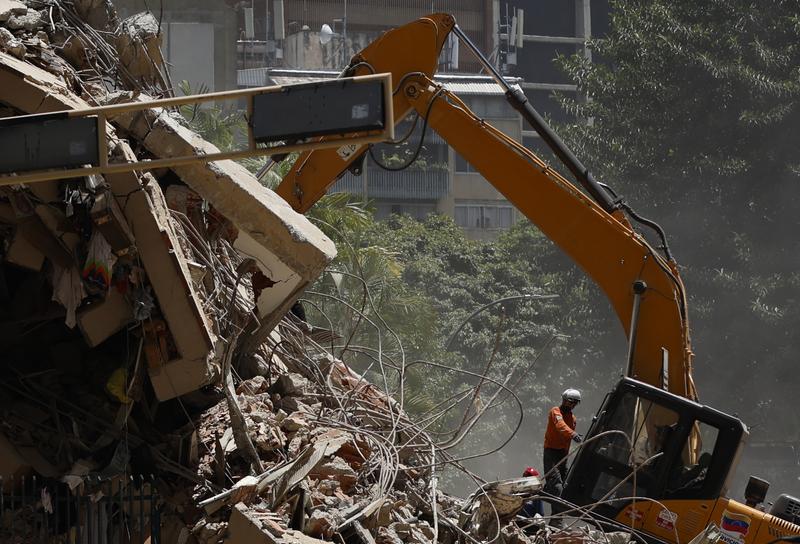
Workers operate heavy machinery to remove debris from a collapsed building in Los Palos Grandes, Chacao Municipality, Miranda State. (Xinhua/Str.)
Experts weigh in
Richard Casanova points to Israel and Japan as leading examples in construction and demolition waste recycling. He believes those experiences “will undoubtedly provide valuable guidance for implementing effective solutions.”
“The challenge is here and now, and we have to get it right,” he adds.
Türkiye’s 2023 earthquake generated approximately 210 million tons of construction and demolition waste, an unprecedented volume that forced authorities to establish temporary collection centers, sorting plans, and recycling programs.
After Japan’s 2024 earthquake, authorities prioritized strict material separation and on-site mechanical processing through mobile crushing plants that quickly reopened key transportation routes. They also expanded circular economy technologies that transformed concrete rubble into new structural materials.
In an interview with The Daily Journal, Abner Mendoza, a leader of the Cement Workers’ Union, alleged that low-quality construction materials had entered the supply chain for several projects across the country. Authorities should investigate those claims thoroughly, particularly because of the implications they could have for recycling and reusing debris generated in Caracas and along the central coast.
According to Casanova, workers can directly reuse about 30% of metals, reinforcing steel, and stone aggregates. Concrete, he explains, must undergo crushing before crews can use it as fill material and as a base for roads built during reconstruction.
International experience shows that post-earthquake management requires strict technical oversight of debris disposal sites, accurate surveys of collapsed or damaged buildings, and the safe recovery of reusable materials, especially metal components.
Both the countries examined and Venezuela will need stronger early warning systems and rigorous enforcement of building codes.
Because, in the end, before, during, and after any disaster, the real goal is to protect human life and rebuild without creating new environmental liabilities. Carpe diem, yes—but never through improvisation or delay.