The Daily Journal.- CNP Caracas documented 134 attacks against the press between January and July 2026.
A report from the monitoring unit of the organization’s Caracas chapter shows a sustained increase in censorship, arbitrary detentions and persecution targeting media workers in Venezuela.
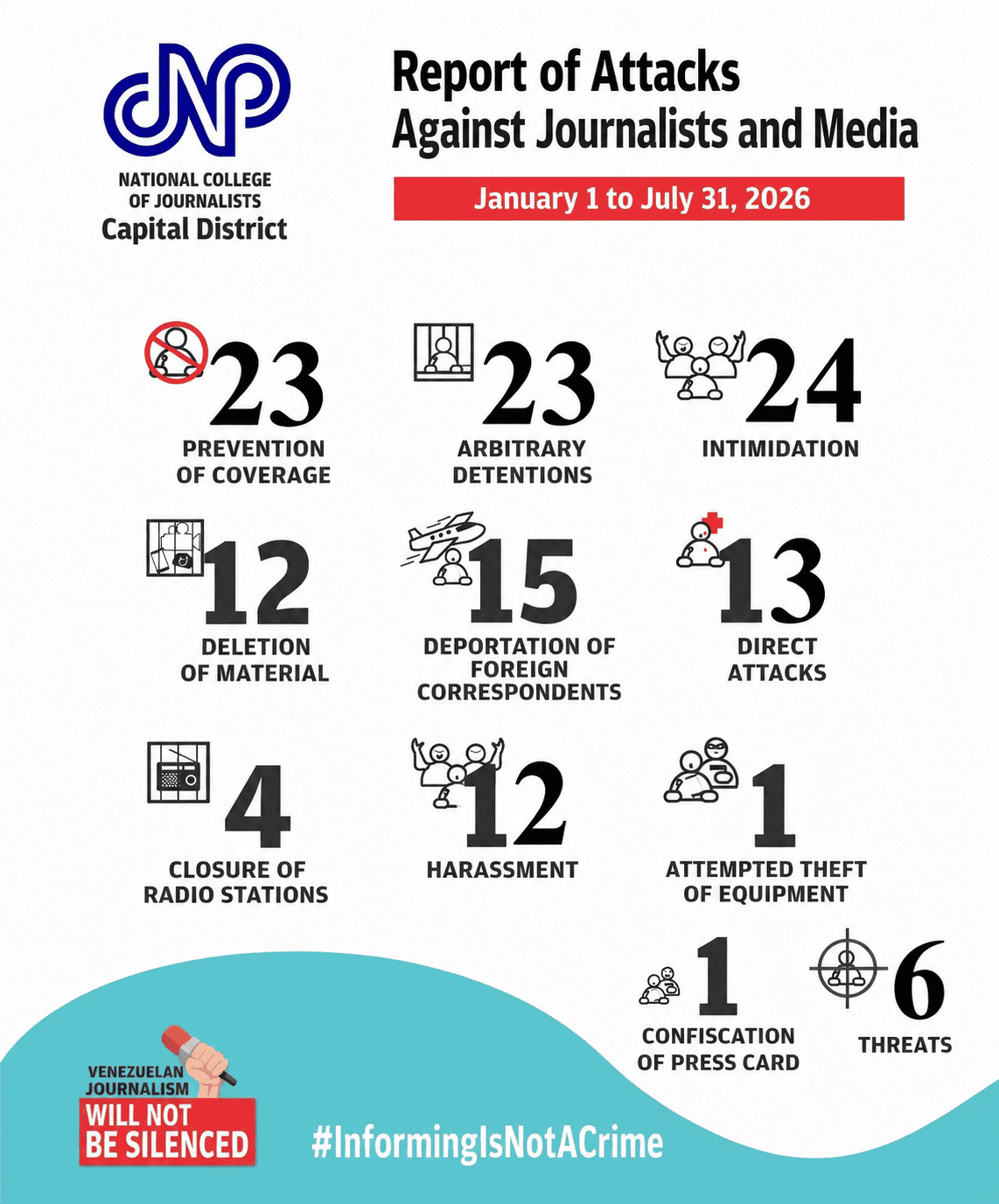
The National Association of Journalists (CNP), Capital District-Caracas chapter, warned about the systematic deterioration of safeguards for the free practice of journalism in the country. After compiling violations of freedom of expression between January 1 and July 31, 2026, its Observatory for Monitoring Attacks recorded a total of 134 attacks against journalists and media outlets.
The report highlights the consolidation of a pattern of institutional and police harassment aimed at obstructing news coverage, particularly during events of major national public interest, including coverage following the earthquakes in June.
Edgar Cárdenas, secretary general of CNP Caracas, warned that Venezuelan journalism operates under a system of structural censorship and a punitive legal framework that seeks to criminalize journalistic work.
“Journalistic work in Venezuela faces constant threats. Authorities continue to resort to coercive rules and measures in an effort to intimidate journalists, encourage self-censorship, and use the judicial system against those who report on reality,” Cárdenas emphasized.
Attacks against the press (January–July 2026)
Intimidation: 24
Obstruction of news coverage: 23
Arbitrary detentions: 23
Deportation of foreign correspondents: 15
Direct attacks: 13
Deletion of journalistic material: 12
Harassment: 12
Threats: 6
Closure of radio stations: 4
Confiscation of press credentials: 1
Attempted theft of equipment: 1
TOTAL ATTACKS: 134
Censorship intensifies during emergencies and public events
The organization’s monitoring efforts recorded 16 new attacks in June, nine of which occurred during coverage following the earthquakes.
Among the documented incidents, the Bolivarian National Police (PNB) prevented journalists from covering events in Altamira, while security forces and civilians harassed and intimidated national television crews and independent reporters in the Caracas metropolitan area and La Guaira.
The report also documented arbitrary detentions near El Helicoide involving journalists such as Maryorin Méndez, Miguel Gutiérrez and Leonardo Fernández, as well as public statements from state officials that sought to discredit and intimidate digital journalists, media outlets and veteran reporters.
In July, the Observatory recorded 21 cases: one obstruction of news coverage, one arbitrary detention, 14 cases of intimidation, one case of harassment and four threats.
Legal vulnerability and professional resistance
Cárdenas reiterated the organization’s concern over the vulnerable situation of six journalists who left detention but continue to face restrictive precautionary measures that limit their ability to exercise their profession and personal freedom fully.
“Despite intimidation and restrictions, CNP Caracas reiterates its unwavering commitment to defending the truth and human rights. Reporting the news is not a crime; it is a fundamental guarantee for citizens,” the union leader concluded.
Source: CNP