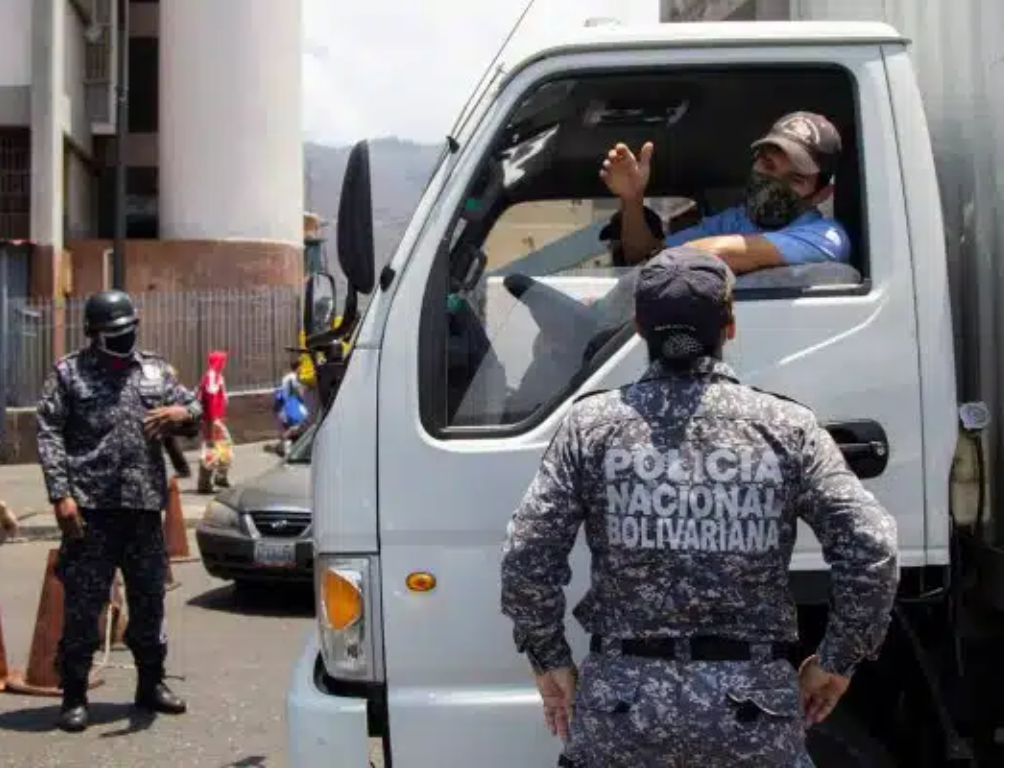
The Daily Journal. — The nongovernmental organization Provea warned that acting President Delcy Rodríguez’s decision to eliminate police and military checkpoints in urban areas across the country will not suffice to dismantle the corruption, extortion and abuse of authority associated with these control points.
Provea said the measure, which authorities presented as a plan to replace fixed checkpoints with mobile patrol units to reduce officers’ discretionary powers, revives a promise made in previous police reform efforts.
“Although eliminating urban checkpoints may look like a positive measure on paper, the announcement alone will not dismantle the network of corruption or arbitrary practices,” the organization said in a statement.
The NGO recalled that for years, citizens have filed complaints against police and military checkpoints over alleged extortion and human rights violations. According to Provea, farmers, agricultural producers, border residents and Indigenous communities rank among the groups most affected.
The organization recalled that after the Kennedy Massacre, which occurred in Caracas in 2005 when members of the Military Intelligence Directorate killed three students from Santa María University, authorities approved a resolution in 2006 to regulate the installation of police and military checkpoints.
That same year, authorities created the National Commission for Police Reform (CONAREPOL), which proposed building a policing model based on the principles of “permanence, efficiency, outreach, democracy and participation.”
However, Provea argued that authorities later reversed progress made through that process. In 2013, during the first year of Nicolás Maduro’s government, the launch of the Patria Segura Plan led to the militarization of public security duties and the installation of thousands of checkpoints throughout the country, according to the organization.
When Maduro announced the plan, he said authorities should implement it “with awareness, passion, commitment and love.”
Provea maintains that less than a month after authorities launched the plan, several serious cases of violence occurred at checkpoints. The organization cited the killing of six people by members of the Bolivarian National Armed Forces (FANB), including a citizen whom officers allegedly tortured and forced to ingest fuel, as well as a shooting that killed four people at a Bolivarian National Guard checkpoint in Falcón.
Checkpoints as extortion sites
Provea said checkpoints no longer serve exclusively as mechanisms for vehicle inspections and crime prevention and, in many cases, have instead become sites of extortion and abuse.
According to the organization, these checkpoints also hinder the exercise of the right to freedom of movement, established under Article 50 of the Venezuelan Constitution, and have negatively affected economic and social rights.
“Far from serving as spaces for vehicle inspections and crime prevention, checkpoints have become sites of extortion and abuse,” Provea said.
The NGO said Indigenous communities and populations living in border areas rank among the affected groups. In Zulia state, for example, residents of the La Guajira region must pass through at least 12 checkpoints between Maracaibo and Paraguaipoa.
Provea denounced that members of the Bolivarian National Guard, the Army, the Bolivarian National Police and the Scientific, Criminal and Forensic Investigations Corps have maintained practices for years that, according to the organization, undermine rights such as access to food, cultural identity, freedom of movement, liberty and personal integrity, particularly among members of the Wayúu and Añú Indigenous communities.
Provea calls for structural reform
The organization said eliminating urban checkpoints could represent progress but warned that its impact will depend on effective oversight and accountability mechanisms.
“Without deep structural reform, these checkpoints could simply move to less visible locations while maintaining the same extortion practices,” it warned.
Provea also raised questions about the future of checkpoints in rural areas and locations far from major urban centers, which Rodríguez’s announced measure may not necessarily cover.
According to the NGO, authorities will need to train officers, modernize preventive intelligence systems and combat impunity to prevent the reported practices from resurfacing through other control mechanisms.
“Simply eliminating one format does not guarantee an end to crime if reporting and sanction mechanisms remain weak,” it said.
The organization also called for policies to remove abusive officers from police forces, greater funding for preventive intelligence and effective action from the Public Prosecutor’s Office to investigate and sanction officials involved in abuses.
“For the elimination of checkpoints to amount to more than a headline, authorities must accompany it with policies to remove abusive officers from police forces, greater funding for preventive intelligence and, above all, guarantees that the state will investigate and sanction officials who continue to commit abuses,” Provea concluded.