Since January 3, Venezuela’s political and economic cards have been reshuffled. The cards in play are gradually being revealed on boards that are constantly changing.
José Gregorio Yépez
In Venezuela, the Trump administration is playing its cards cautiously. It is sending signals that seem contradictory and fall outside the expectations of those who bet on an abrupt break, with María Corina Machado as the protagonist, and failed to anticipate a gradual process that could ultimately become a “negotiated transition.”
Politicians talk about playing on several boards at once, and the strategy of the president of the United States seems to fit that approach perfectly.
This means the three-phase process proposed by the United States — stabilization, recovery and transition — follows a linear, chronological path, although at times the variables move forward in parallel.
The calls for elections, loudly demanded by one sector of the opposition in the very short term, have gone unheeded by the Trump administration, which has addressed the issue in the words of the U.S. president himself: “We want elections. Delcy wants them too, but they’re not ready yet.” Or, as he said in Texas last week: “Right now it’s a very delicate issue. I think it’s too soon.”
ECONOMICS AND POLITICS
The first significant actions after January 3 came on the economic front. The evidence? The approval of the Hydrocarbons Law reform less than a month after the military intervention.
This reveals the external actor’s interests, which now directly influence the country’s decisions. The first measure went straight to the heart of the Venezuelan economy: oil.
Then came two signals regarding repression, one of the most criticized aspects of the Maduro government: the reform of the Statute of the Criminal Investigation Police Law and the Amnesty Law. At that point, authorities began releasing political prisoners.
At the same time, sanctions began to ease through the approval of new licenses by the Office of Foreign Assets Control (OFAC), which have continued to appear periodically.
During that period, lawmakers also reformed the Mining Law, while the National Assembly addressed legislation concerning the real estate sector.
Against this backdrop, the government announced around June the beginning of a Dialogue Roundtable between the government and representatives of the 2015 National Assembly. On June 18, Jorge Rodríguez received Dinorah Figuera at the Federal Legislative Palace.
Six days later, the double earthquake of June 24 shifted the board once again.
The emergency pushed the political issue out of the public spotlight, although discussions obviously continued, albeit at a very low volume.
In August, the first round of talks began. Once it ended, authorities released more political prisoners. Toward the end of that month, the “historic” oil agreement with the United States covering 65 billion barrels of Venezuela’s proven reserves received approval.
In this brief overview of events in Venezuela since January 3, we can see how economic and political actions unfolded in stages. Economic measures opened the door, followed by responses involving political guarantees and recognition, as well as other measures related to human rights.
These actions then connect with further decisions on the economic front. This is where we can see the different boards on which U.S. geopolitics plays its game in Venezuela, and the responses from the Rodríguez administration as it interacts with the White House.
The continental power “pulled out the gun,” asserted its hegemony and tied local political actors “belly to belly” to demand discipline in accordance with its interests.
NEW YORK, NEW YORK
Then September arrived, and Delcy Rodríguez set foot in New York to address the United Nations.
But she did more than simply arrive in New York. It represented the symbolic and concrete return of Miraflores to the Western orbit — to the sphere of influence from which Chávez and Maduro removed Venezuela, as political scientist and social psychologist Ricardo Sucre argues.
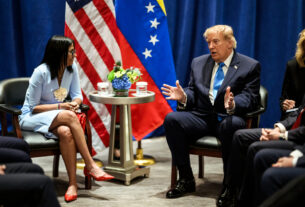
Meetings with the World Bank Group and the International Monetary Fund, along with the first meeting between the presidents of the United States and Venezuela in 11 years, mark a new relationship and a new logic in the Venezuelan government’s foreign policy.
In her address to the United Nations General Assembly, the acting president said Venezuela was pleased “to announce that Venezuela has begun a process of democratic transformation to build, through an orderly, institutional and verifiable process, a country that is freer for everyone, more prosperous and more reconciled with itself.”
She added that this is “a process of political, economic and spiritual change. Of structural reforms for the rebirth of Venezuela, for the rebirth of our nation, for the rebirth of our people. It is about building a country where no one has to win by disregarding the other.”
Delcy Rodríguez, aware of the pressure to determine whether Venezuela is undergoing a transition and to define the nature of the events unfolding on the political and institutional fronts, carefully crafted words intended to provide answers.
“History has taught us that some of the strongest democratic transitions in the contemporary world did not emerge from rupture, but from transformation firmly led from within the institutions themselves. That is the inspiration — not the reproduction of someone else’s history or of the past, but the lesson of a universal idea,” she declared.
And she concluded: “Legality can be the path toward better legality. A nation is not reborn simply by rebuilding buildings; it is reborn when it rebuilds trust in its institutions.”
A NEGOTIATED TRANSITION?
Delcy Rodríguez’s speech points toward the idea that she could lead the transition and that the political sector she represents could guarantee a process with the lowest possible cost to society.
So the question arises… Are we in a transition process?
“No!” political scientist and university professor John Magdaleno insists emphatically.
For the political consultant, a genuine transition begins when those who hold power decide to recognize and restore fundamental civil liberties, such as freedom of expression, freedom of the press, freedom of association and assembly, and habeas corpus. This is the initial phase, or “liberalization.”
Looking at the Venezuelan landscape, the academic says the signals point in that direction, although he still considers them timid.
“Have the formal rules of the game changed? Who makes the decisions? De facto, yes, because foreign tutelage has taken hold and decisions are currently coming from Washington. But… what about the local authorities? Who maintains public order in the country? Who constitutes a center of political activity in the country? The fact that there is tutelage does not mean that the rules have changed,” he argues.
Magdaleno says the most successful and viable way to move from an authoritarian regime to a democratic one is a “negotiated transition,” according to his research and case studies spanning more than a decade.
For this to happen — while reducing the risk of an authoritarian reversal — the restoration of fundamental civil and political liberties must come with guarantees for the dominant coalition and reduced exit costs.
TRUMP’S CARDS
Donald Trump’s strategy toward Venezuela does not appear to have been challenged by the famous phrase from James Carville, Bill Clinton’s campaign adviser: “It’s the economy, stupid.”
The U.S. leader knows a thing or two about that.
He has sent a clear signal to the entire world that Venezuela is an economic issue that requires a political solution.
Recent moves suggest that María Corina Machado does not appear to be the card the White House needs for Venezuela right now. That is why Trump is not playing it; he is keeping her off the board.
Still, no one should be fooled: in politics, nothing is ever entirely ruled out if its moment arrives.
Machado, or someone equivalent to her, could be a card held in reserve for the moment the White House needs it, and that is precisely what those who hold power in Venezuela want to prevent.
The “dominant coalition” is seeking to prevent María Corina Machado, or someone equivalent to her, from becoming necessary to the United States, whether Trump wins or loses the midterm elections, and whether or not Trump remains in the White House.
The “dominant coalition” is playing its cards too.
Those in power in Venezuela ordered news websites to be unblocked — something that is happening only gradually — sending a signal of greater openness toward freedom of expression.
They also ordered the full release of journalist, human rights activist, and defender Rocío San Miguel.
The acting president called for a review of the Law Against Hate and acknowledged “excesses” in its enforcement.
For now, the game continues with the cards currently on the economic, political, and geopolitical boards.
What will happen in the medium term?
The questions begin again: Will these signals be enough for Venezuela to enter a transition process truly? Are we heading toward a negotiated transition? Does the pact include María Corina Machado? All of the above?
We have no crystal ball to tell us.
We simply keep our feet firmly on the ground, assessing the political, economic, and social events unfolding in this Land of Grace.
The game goes on.