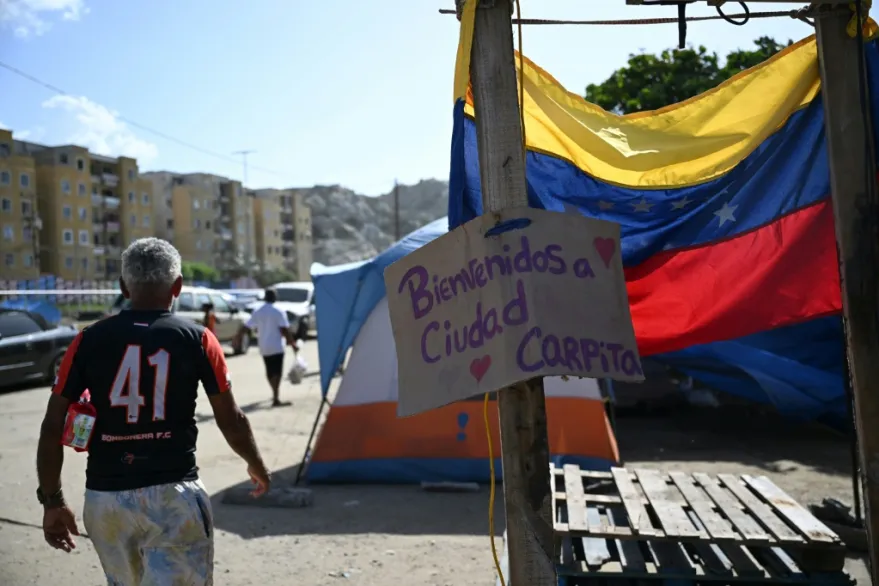
AFP. — “Welcome to Tent City,” reads a sign next to a Venezuelan flag at the entrance to a camp for earthquake survivors in the devastated state of La Guaira.
Having accepted that the wait will be long, families are beginning to organize their lives inside tents at this improvised shelter in La Guaira, ground zero for the magnitude 7.2 and 7.5 earthquakes that struck Venezuela on June 24 and have already claimed nearly 5,000 lives.
“We have to move forward. We have to be grateful that we have another chance,” 38-year-old Hengelbert Bello told AFP. He lost several family members in the earthquakes.
“But we have to keep a clear purpose and a clear mind so we can continue living and help those who are still with us,” he said.
Before the disaster, Bello lived with his family in Gran Cacique Mare Abajo, a residential complex of about 1,000 apartments built during the administration of Hugo Chávez (1999–2013). The earthquakes reduced the complex to rubble.
Since then, he and his neighbors have made the beach across the street their new home.
Between rows of tents, residents carry out everyday chores in the open air while two young girls bathe in the sea.
They share refrigerators and cook with gas cylinders over large communal pots. Some residents also rent portable washing machines for $5.
“Even in the middle of everything we’re going through, we have to do everything we can to keep things clean and organized,” said Eunice Hernández, 45, the mother of two teenagers.
“If God gave us another chance, then we have to keep moving forward.”
“So many dreams stayed behind”
Electrical appliances are powered by a cable connected to a public streetlight, although power outages occur frequently.
Authorities send a water truck every day so residents can fill their portable tanks free of charge.
According to official figures, nearly 21,000 people affected by the earthquakes are living in camps across Caracas and La Guaira. Many of those camps lack sufficient water and portable toilets.
Doctors working in field hospitals throughout the area are trying to prevent respiratory and intestinal diseases from spreading.
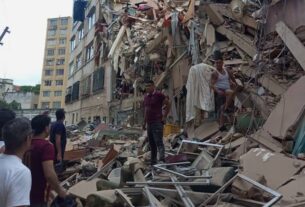
Official figures indicate that the earthquakes brought down at least 185 buildings in La Guaira and damaged nearly 900 more.
Several apartment buildings where these families once lived split in two and shifted several centimeters backward under the force of the powerful earthquakes.
“Every time I come here, I feel overwhelmed with sadness because no one wants to go through something like this,” 42-year-old barber Ramón González said through tears as he pointed to the tower where he once lived.
On the day of the earthquakes, a teenage girl who had been preparing to celebrate her quinceañera lost her life.
“It breaks my heart because she was like a daughter to me… So many dreams stayed behind here,” he said.
González also mourns the loss of the home he shared with his wife and their four children. They now live in the shelter alongside two older adults who have no family.
“We’ve survived so much,” he said.
“I’ll wait as long as it takes to get my home back.”