By Óscar Reyes Matute
Becoming an influencer by explaining mathematics sounds almost impossible. Hannah Fry has managed to do it. If you teach at the University of Cambridge, deliver TED Talks, anchor programs for the BBC, and possess undeniable charisma, you have already won half the battle. But if your favorite subject happens to be the mathematics of love, the algorithms will surely reward you.
Fry argues that we fall in love through biological optimization algorithms that search for the best possible partner. The brain weighs risks and compares early relationships to establish a benchmark before choosing a love that exceeds that average, constantly calculating probabilities to maximize stability and reproductive success.
Love endures through continuous calibration and a low tolerance for negativity. Couples who communicate and resolve everyday frictions as they arise prevent destructive momentum from taking hold.
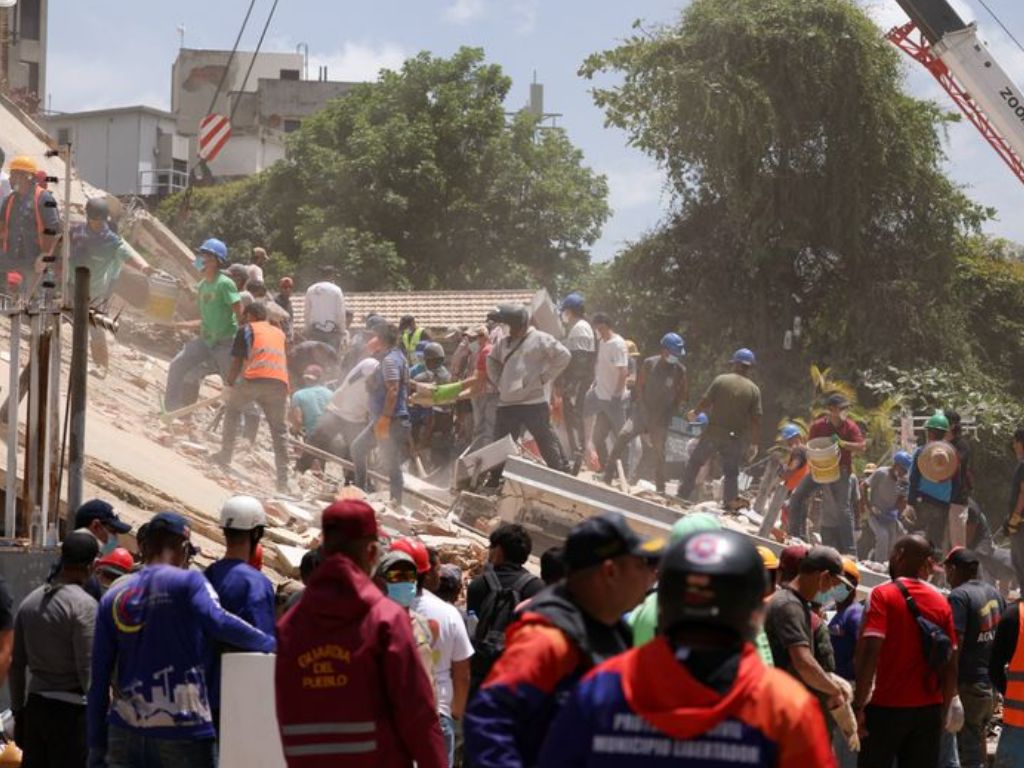
Mutatis mutandis, mathematics also offers a model for loving one’s neighbor and understanding solidarity with earthquake victims. Evolutionary game theory, reciprocal altruism, and Hamilton’s rule all suggest the same principle: cooperation flourishes whenever the collective benefit outweighs the individual cost. Robert Axelrod and Martin Nowak argue that solidarity during a crisis—as Venezuela has experienced—becomes a strategy for collective survival. Yet that initial willingness to help declines exponentially toward social fatigue unless institutions step in to sustain it and reduce the inevitable wear.
Solidarity is easy to defend in speeches. Building an economic model capable of sustaining it over the long term has proved far more difficult. Its sustainability threshold remains remarkably low, and both public and private efforts in relief and reconstruction must outpace the rapid decline of public expectations. Otherwise, deep social unrest—or even outright anomie—becomes a real possibility.
Suppose, for a moment, that we are not talking about Venezuela. Imagine a country where the State, citizens, and political leaders respond with extraordinary efficiency; where, despite the turbulence of political transition, coordinated agreements drive reconstruction forward; where Trump’s Marshall Plan, later continued by Marco Rubio, works flawlessly; and where multilateral institutions, domestic investors, and international capital pour substantial resources into rebuilding.
Even under those ideal circumstances, Ricardo Hausmann, Oxford Economics, the World Bank, and the Inter-American Development Bank estimate that restoring basic services and addressing the emergency would still require two to three years, while rebuilding productivity, industry, and pre-crisis levels of consumption would take 12 to 18 years.
Solidarity rarely lasts that long—even if the Catholic Church leads it.
Perhaps that reveals the deeper problem: we still tend to view solidarity as charity. The one who gives earns heaven; the one who suffers and receives eventually hopes for a better life in heaven as well.
But in this world, those who give eventually burn out, while those who receive often become permanent refugees within their own homeland.
Could solidarity evolve into social capital, into new ways of generating wealth for an entire nation? Could volunteers transform their donated hours into assets that compensate for the personal cost of helping? Could people who possess nothing but their own hands in shelters and neighborhoods invest time in compensated volunteer work? Under those conditions, volunteering might remain sustainable over the long term.
In 1980, Edgar S. Cahn developed the Time Dollar System (TDS) at the London School of Economics. The idea resembled a bank where people accumulated volunteer hours, each valued at one dollar per hour, and exchanged them for another volunteer’s hours. One hour of pediatric care could pay for one hour of gardening or assistance for an older adult.
The experiment succeeded in Chicago through much of the 1990s. Children in low-income neighborhoods accumulated hours that they later exchanged for used computers, services, and goods donated by businesses that voluntarily joined the TDS network. Yet the project never reached a larger scale. Reliable methods to validate working hours and verify exchanges simply did not exist. Smart contracts and digital tokens had not yet emerged. Volunteers relied on Excel spreadsheets and mutual trust.
Communities that continue experimenting with the model rarely grow beyond 100 to 150 participants, largely because everyone already knows one another.
Scaling the model would require highly organized networks built on trust and shared purpose. A nationwide TDS could function through a smartphone application, operating as naturally as a mobile payment platform.
A mother who sweeps her neighborhood sidewalks or a bricklayer who repairs a school’s wall could earn five Time Dollars in a single day. Through partnerships with businesses—perhaps even with someone like Lorenzo Mendoza—those credits could purchase a kilogram of Harina PAN, a can of tuna, a kilogram of rice, tomatoes, onions for lunch, or even medications at participating pharmacies.
John Lennon once said, “Imagine.”
At this point, what else do Venezuelans have left to lose?
Perhaps, instead, they have an opportunity to help create a new world.